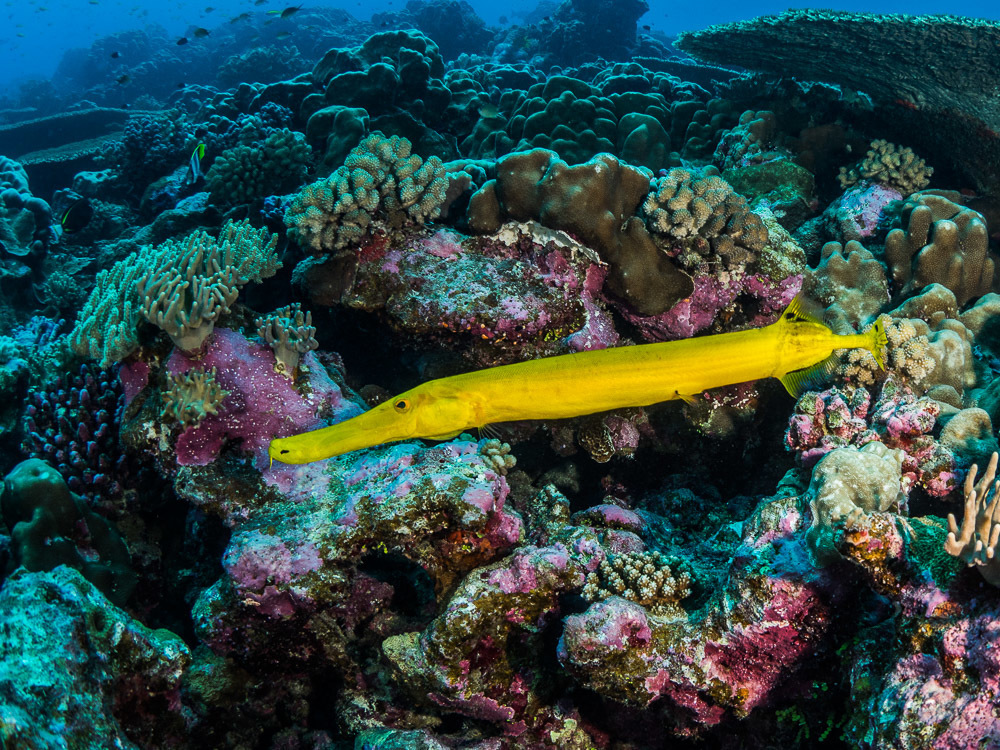
Trumpetfish in Mauritius – The Reef's Master of Disguise
The Trumpetfish (Aulostomus chinensis), known locally as Poisson trompette, is one of the most distinctive and entertaining fish you can encounter on the coral reefs of Mauritius. With its elongated, pipe-like body, upturned snout, and almost comical patience as a predator, the Trumpetfish is an unmistakable character of the Indo-Pacific reef ecosystem.
Identification & Appearance
Trumpetfish can grow up to 80 cm in length, making them among the larger fish you'll encounter on Mauritian reefs despite their remarkably slender profile. Their tubular body, small dorsal spines, and distinctive chin barbel make them easy to identify once you know what you're looking for. Colouration is highly variable — individuals can appear yellow, brown, grey, or greenish, and they are capable of rapid colour changes to match their surroundings. A pale lateral line and subtle banding add to their cryptic appearance. Their long, fluted snout ends in a small mouth that opens like a vacuum to inhale prey whole.
Behaviour & Hunting Strategy
What truly sets the Trumpetfish apart is its remarkable hunting technique. Rather than actively chasing prey, it uses stealth and deception. A Trumpetfish will often hover motionless in a vertical position among branching corals, sea whips, or gorgonian fans, mimicking a piece of floating debris or a strand of coral. This behaviour, known as cryptic stalking, allows it to drift almost imperceptibly close to small fish and crustaceans before unleashing a lightning-fast strike.
Even more fascinating is the Trumpetfish's habit of shadowing other larger fish — such as parrotfish or surgeonfish — to conceal its approach. By tucking itself alongside a non-threatening species, it gets within striking distance of unsuspecting prey that would otherwise flee. This clever strategy, sometimes called shadow hunting, is a joy to observe and is frequently witnessed on Mauritian reefs.
Habitat in Mauritius
In Mauritius, Trumpetfish are common across a wide range of reef environments, from the shallow lagoon patch reefs to the outer reef walls and slopes that plunge into deeper blue water. They are particularly fond of areas with rich coral growth, sea fans, and gorgonian corals where their camouflage is most effective. You'll often spot them hanging in the water column near the reef edge, barely moving, or gliding slowly alongside larger reef fish. Depths of 2 to 30 metres are typical, making them accessible to snorkellers and scuba divers alike.
Diet & Ecology
Trumpetfish are carnivorous ambush predators, feeding primarily on small fish, shrimps, and other crustaceans. Their expandable, pipette-like jaws create powerful suction, allowing them to engulf prey in a fraction of a second. Despite their solitary hunting style, they play an important role in maintaining the ecological balance of reef fish populations in Mauritius.
Underwater Photography Tips
The Trumpetfish is an excellent subject for underwater photographers. Their slow, deliberate movements and tendency to stay motionless make them easier to frame than many reef fish. Look for them hovering near sea fans or drifting alongside parrotfish. Use a medium wide-angle or macro lens to capture the full length of their body and the intricate detail of their snout. Approach slowly and avoid sudden movements — while they are not especially shy, abrupt behaviour can send them drifting away behind the nearest coral head.
Conservation Status
The Trumpetfish is currently listed as Least Concern on the IUCN Red List. In Mauritius, populations appear healthy and stable, reflecting the overall resilience of this adaptable species. Supporting responsible reef conservation and choosing eco-certified dive operators in Mauritius helps protect the habitats that Trumpetfish and hundreds of other species depend on.