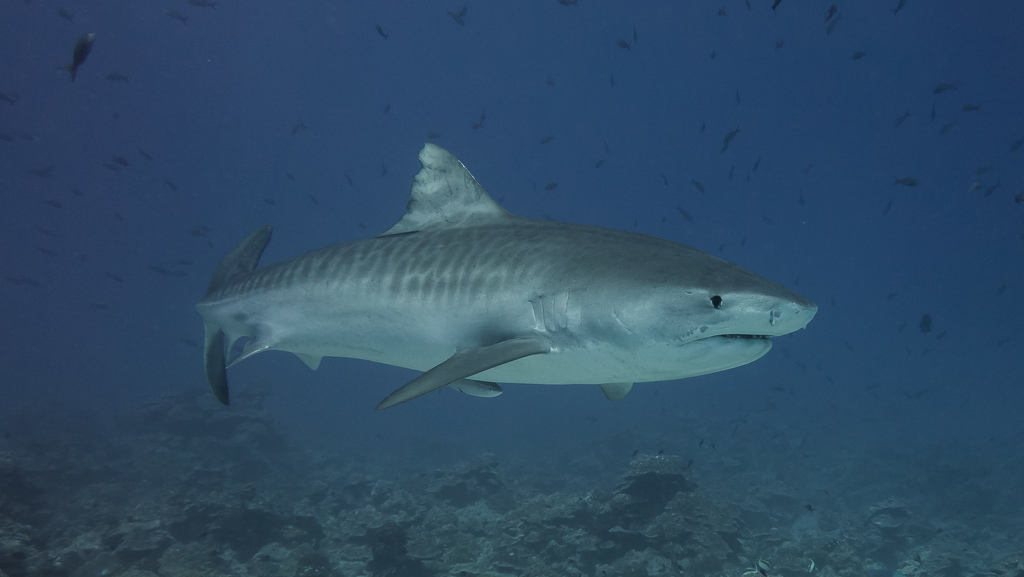
Tiger Shark in Mauritius: The Ocean's Apex Predator
The tiger shark (Galeocerdo cuvier), known in Mauritius as the Requin tigre, is one of the most iconic and formidable sharks in the world's oceans. Belonging to the family Carcharhinidae, it ranks as the second-largest predatory shark after the great white, regularly reaching lengths of 3.5 to 4.5 metres, with exceptional individuals exceeding 5 metres. Its distinctive dark, tiger-like vertical stripes — more pronounced in juveniles and fading with age — make it unmistakable in the water.
Physical Characteristics
The tiger shark's body is built for efficiency and power. It features a broad, blunt snout, large eyes adapted for low-light hunting, and uniquely serrated, cockscomb-shaped teeth designed to tear through a wide variety of prey. Its colouration ranges from blue-grey to dark grey on the dorsal side, with a pale or white underbelly. The characteristic stripes and spots that give this species its name are especially vivid in younger sharks and gradually fade as the animal matures into adulthood.
Behaviour and Diet
Tiger sharks are renowned as one of the ocean's most opportunistic feeders, earning the nickname 'the garbage cans of the sea.' Their diet is extraordinarily diverse, encompassing fish, rays, sea turtles, dolphins, seabirds, squid, and even carrion. They are primarily nocturnal hunters, becoming more active at dusk and during the night when they move into shallower waters to feed. During daylight hours, they tend to cruise deeper offshore zones, making daytime encounters particularly special and rare.
Tiger Sharks in Mauritius
In Mauritian waters, tiger shark sightings are genuinely rare events that occur sporadically throughout the year. Unlike some Indo-Pacific destinations where tiger sharks are baited for regular encounters, Mauritius does not conduct shark feeding dives, meaning sightings are entirely based on chance and the natural movement of individual animals. Tiger sharks in Mauritius are most likely to be encountered along the outer reef slopes, deep channels, and offshore blue water zones — areas where the island's shallow lagoon gives way to dramatic oceanic depths.
The waters around the southern and eastern coasts of Mauritius, characterised by exposed reef edges and strong oceanic currents, represent the most probable habitat for transient tiger sharks. These individuals are typically pelagic travellers, moving across vast stretches of the Indian Ocean and passing through Mauritian waters rather than establishing permanent residency.
Diving with Tiger Sharks
Encountering a tiger shark while diving in Mauritius requires patience, experience, and a degree of luck. Divers exploring deep outer reef dive sites, particularly those with significant drop-offs and healthy fish populations, stand the best chance of a sighting. It is essential to approach any potential encounter with composure: maintain a calm, non-erratic swimming posture, avoid sudden movements, and never attempt to touch or corner the animal. Experienced dive guides familiar with local waters will always brief divers on appropriate behaviour around large sharks.
Tiger sharks are naturally curious animals and may make close passes to investigate divers. While this can appear intimidating, the vast majority of encounters are non-aggressive when divers behave respectfully. Always dive with a reputable operator who prioritises both diver safety and the welfare of the marine environment.
Conservation of Tiger Sharks
Globally, tiger sharks face significant pressures from targeted fishing for their fins, liver oil, and flesh, as well as incidental bycatch in longline fisheries. Their slow reproductive rate — females give birth to litters of 10 to 80 pups approximately every three years — makes population recovery challenging. In Mauritius, sharks benefit from growing awareness campaigns and marine conservation initiatives, though comprehensive shark-specific protection legislation remains an area for further development. Supporting responsible ecotourism and reporting sightings to local marine research organisations helps contribute valuable data to tiger shark conservation efforts across the Indian Ocean.