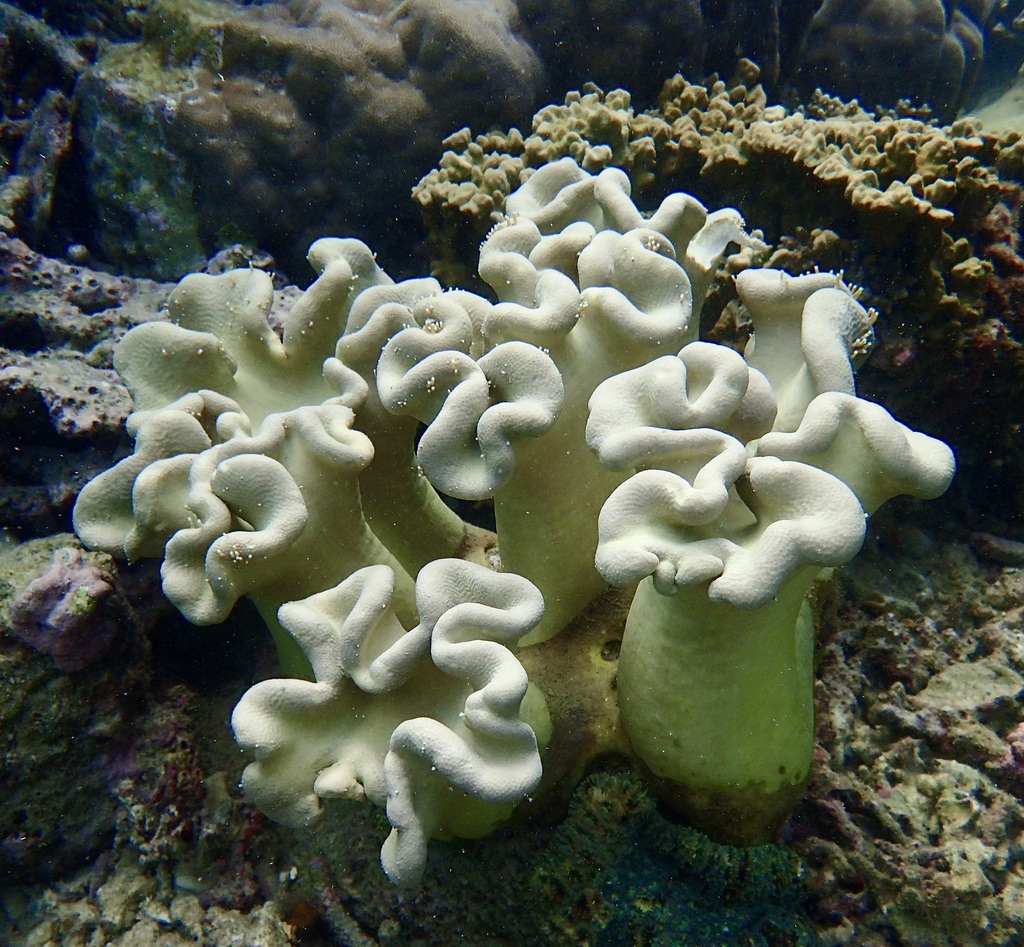
Soft Leather Coral (Sarcophyton spp.) in Mauritius
Among the many coral species that decorate the reefs of Mauritius, few are as immediately recognisable as the soft leather corals of the genus Sarcophyton. Known locally as Corail mou cuir, these octocorals belong to the family Alcyoniidae and are a defining feature of Indo-Pacific reef ecosystems. Their common name is well-earned: the surface of a Sarcophyton colony has a distinctly leathery texture, and the colony itself forms a broad, lobed cap atop a thick stalk, resembling a toadstool or mushroom as it matures.
Identification and Appearance
Sarcophyton colonies can range in colour from pale cream and beige to golden yellow, olive green, or grey-brown. The upper surface — called the capitulum — is densely covered with two types of polyps: autozooids, which are feeding polyps bearing eight feathery tentacles, and siphonozooids, which are much smaller and handle water circulation within the colony. When the feeding polyps are extended, the colony takes on a fuzzy, almost flower-like appearance. When disturbed, the polyps retract and the colony deflates, shrinking noticeably in size. Mature colonies can reach impressive proportions, with some exceeding 50 cm in diameter, making them conspicuous landmarks on the reef.
Role on the Reef
Far from being passive decorations, soft leather corals play a vital ecological role. They compete actively for space on the reef, often releasing allelopathic chemicals — natural toxins — to inhibit the growth of neighbouring corals and organisms. This chemical warfare is one reason why Sarcophyton colonies are often found with a clear zone of bare substrate around them. Despite their toxicity to competitors, these corals provide shelter and substrate for a host of reef associates, including small gobies, cowries, and nudibranchs that feed on their tissues. Certain species of pygmy seahorses and hawkfish are also known to rest among soft coral colonies.
Soft leather corals do not build calcium carbonate skeletons like hard corals. Instead, their structure is supported by tiny calcified spicules called sclerites embedded in a fleshy matrix. This makes them more flexible and resilient to wave action and current, but also means they do not contribute directly to reef framework construction. They do, however, contribute significantly to reef biodiversity and are an important food source in the reef food web.
Where to Find Sarcophyton in Mauritius
In Mauritius, Sarcophyton soft corals are classified as common and can be encountered on a wide variety of dive sites around the island. They favour sheltered reef slopes, lagoon walls, and the upper edges of drop-offs where moderate currents deliver a steady supply of plankton. They are typically found at depths ranging from 5 metres to 30 metres, making them accessible to both beginner snorkellers and experienced technical divers. The warm, clear waters of the Mauritian lagoon system create ideal conditions for their growth, and colonies are frequently encountered alongside sea fans, hard corals, and feather stars.
Best Time to See Them
Soft leather corals are a year-round presence on Mauritian reefs, but visibility and diving conditions are generally best between May and December, during the cooler, calmer dry season. Water temperatures during this period range from around 23°C to 27°C, and reduced rainfall means clearer water and better observation opportunities. During summer months (January to April), cyclone-related swells can temporarily reduce visibility but do not significantly affect the corals themselves.
Conservation and Resilience
While Sarcophyton soft corals are considered relatively resilient compared to many hard coral species, they are not immune to the pressures facing Mauritius's reef systems. Pollution, sedimentation, anchor damage, and irresponsible diving can all harm colonies. Their natural toxins offer some protection against biological threats, but bleaching events driven by rising sea temperatures have been observed in soft corals as well. Mauritius has implemented marine protected areas and moorings at many popular dive sites to reduce anchor damage, measures that directly benefit soft coral communities.