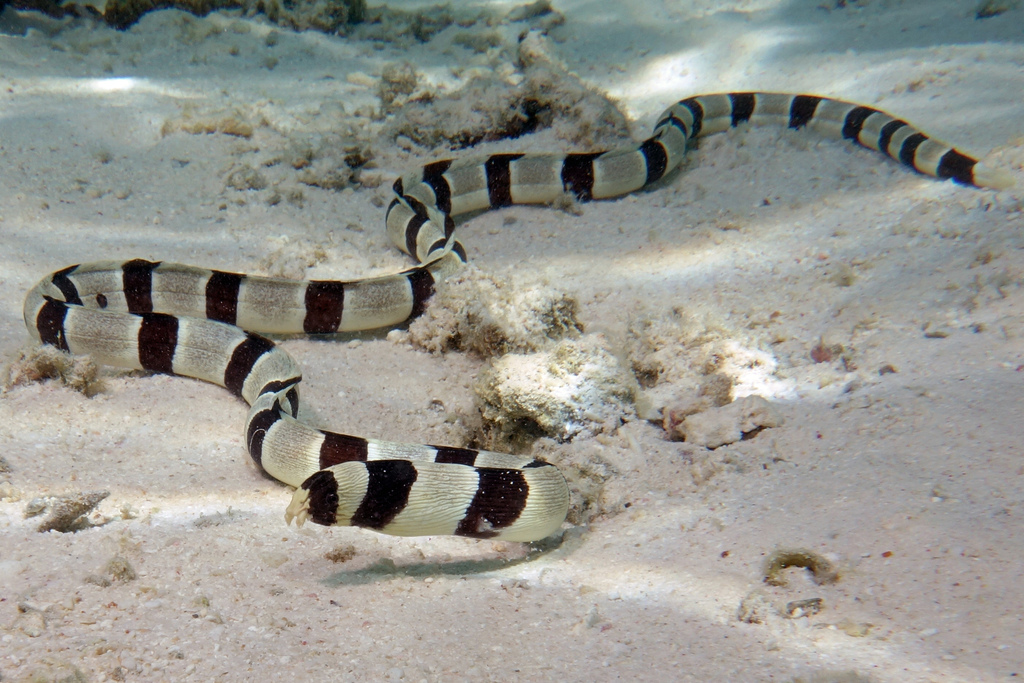
Banded Snake Eel in Mauritius – Complete Diver's Guide
The banded snake eel (Myrichthys colubrinus), known locally as Anguille Serpent, is a captivating member of the family Ophichthidae that inhabits the warm, clear waters surrounding the island of Mauritius. Unlike the moray eels that most divers are familiar with, the snake eel spends much of its life partially buried in sandy substrates or slithering gracefully across the seafloor in open view, making it both elusive and surprisingly visible when active.
Appearance and Identification
Myrichthys colubrinus is immediately recognizable by its bold, alternating black and white banded pattern, which runs the full length of its cylindrical, serpentine body. Adults typically reach between 80 cm and 100 cm in length, though larger specimens approaching 120 cm have been recorded in Mauritius. The pointed, hard snout — perfectly adapted for burrowing into sand — and the lack of pectoral fins give it a distinctly snake-like silhouette. This mimicry of venomous banded sea kraits (genus Laticauda) is believed to be a form of Batesian mimicry, offering protection from predators.
Behaviour and Ecology
Snake eels are predominantly nocturnal hunters, emerging from their sandy burrows at dusk and dawn to forage for small fish, crustaceans, and invertebrates. However, in Mauritius they are regularly observed during daylight hours, particularly in the early morning. Their hunting technique is mesmerizing — they probe the sand with their pointed snout, flushing out hidden prey with rapid, fluid movements. When threatened, they quickly reverse tail-first into the sand, disappearing with surprising speed.
Unlike many reef fish that are territorial and sedentary, snake eels are active wanderers. They travel considerable distances across the sandy channels and rubble zones that separate coral bommies, making them exciting subjects for underwater photography. Their movement is a beautiful, undulating ripple that flows from head to tail, almost hypnotic to watch.
Habitat in Mauritius
In Mauritius, banded snake eels are most commonly found on sandy reef flats, lagoon floors, and rubble zones at depths ranging from 1 metre to around 30 metres. They show a preference for areas where coarse white sand meets coral reef edges — environments that offer both hunting grounds and refuge. The shallow lagoons on the western and northern coasts, with their calm, clear waters and sandy corridors between patch reefs, provide ideal habitat. Divers and snorkelers exploring the inner lagoon near sites like Blue Bay and Trou aux Biches regularly encounter them on early-morning dives.
Photography Tips
Photographing snake eels requires patience and a slow approach. Move parallel to the eel rather than directly toward it, and keep your buoyancy precise to avoid stirring up sand. A wide-angle or macro lens works well depending on how close you can approach. Early morning dives offer the best chances, as eels are most active and the low angle of light creates stunning contrast on their banded bodies. Avoid using a torch directly on the eel — ambient light photography produces far more natural and rewarding images.
Conservation and Status
The banded snake eel is currently classified as a species of Least Concern by the IUCN. In Mauritius, the species benefits from the country's expanding network of marine protected areas and the general health of fringing reef ecosystems. While not specifically targeted by fisheries, snake eels can occasionally be caught as bycatch. Responsible diving practices — no touching, no disturbing burrows, and maintaining safe distances — ensure these animals continue to thrive for future generations of divers to enjoy.
Why Mauritius is Special for Snake Eel Encounters
The diversity of Mauritian reef habitats, from shallow turquoise lagoons to deeper outer reef slopes, means snake eels can be encountered across a wide range of dive experiences. Their common presence in Mauritian waters makes them a reliable and exciting sighting rather than a rare prize, and their dramatic appearance ensures every encounter is memorable. Whether you are completing your first open-water dive or leading a group of experienced underwater photographers, the banded snake eel of Mauritius never fails to impress.