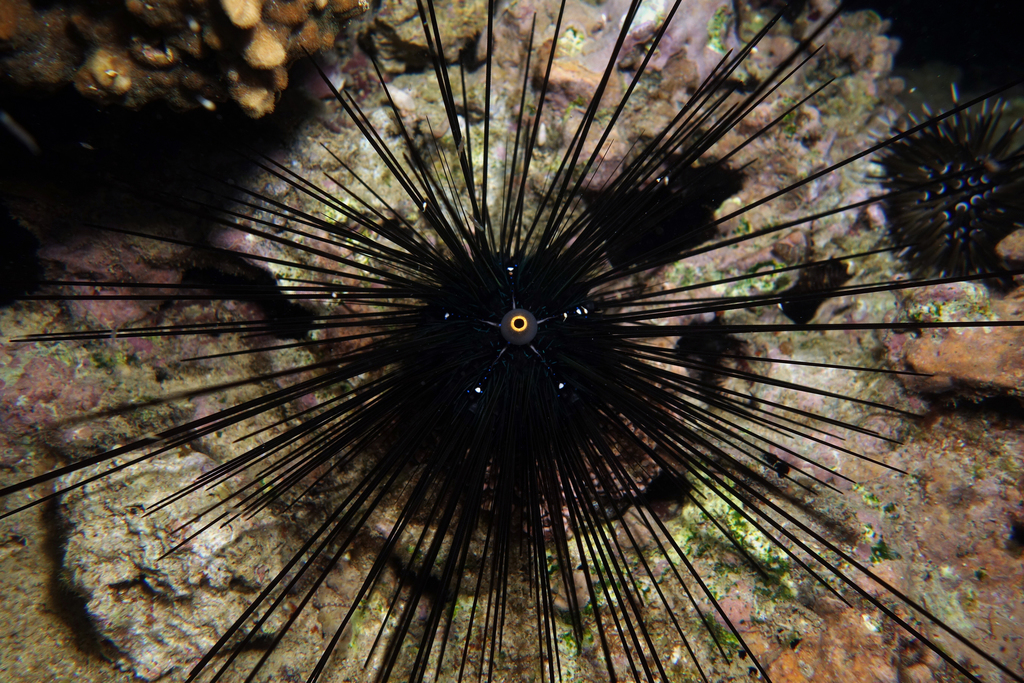
Diadema Sea Urchin in Mauritius — Diadema setosum
The Diadema sea urchin, known locally as Oursin diadème and scientifically as Diadema setosum, is one of the most recognisable invertebrates on the coral reefs of Mauritius. Belonging to the family Diadematidae, this species is distributed across the Indo-Pacific and is a dominant echinoderm presence throughout the shallow reefs, lagoons, and fore-reef slopes that fringe the Mauritian coastline.
Physical Description
Diadema setosum is immediately identifiable by its long, hollow, venomous spines that radiate from a spherical, flattened test (shell) typically measuring 6–10 cm in diameter. The spines themselves can reach an extraordinary 25–30 cm in length, making the animal appear far larger than its body alone suggests. The test is deep black or dark brown, and a striking orange-red ring around the anal cone on the upper surface is a diagnostic feature that distinguishes Diadema setosum from closely related species. The tube feet, which the urchin uses for locomotion and anchoring, are clearly visible between the spine bases.
Behaviour and Ecology
Diadema urchins are primarily nocturnal grazers, emerging from their daytime shelters in crevices and under coral ledges after dark to feed on encrusting algae, turf algae, and detritus. This grazing behaviour makes them ecologically vital: by controlling algal overgrowth, they keep reef surfaces clear and available for coral larval settlement. In Mauritius, Diadema setosum often aggregates in dense clusters, particularly on reef flats and rubble zones, where their combined grazing can maintain biologically rich reef patches.
During the day, individuals retreat to sheltered microhabitats — tucked beneath table corals, wedged into reef crevices, or nestled among rock outcrops. Interestingly, their spines exhibit a weak phototropic response, orienting toward light sources, which is thought to serve a defensive function. Juveniles are often found in shallower, more sheltered areas like seagrass beds and sandy lagoons before migrating to deeper reef habitats as they mature.
Interaction with Divers and Snorkelers
While Diadema setosum presents no aggressive behaviour toward humans, its long, brittle spines are a real hazard. The spines are barbed and break off easily upon contact with skin, embedding deeply and causing sharp pain, localised inflammation, and in some cases secondary infection. Divers and snorkelers should always maintain good buoyancy control and avoid touching or kneeling on reef surfaces where urchins are present. In the event of a spine puncture, it is recommended to remove accessible fragments carefully, clean the wound thoroughly, and seek medical advice if symptoms worsen. Contrary to popular belief, urinating on the wound is not an effective remedy.
Role in Reef Health
The ecological importance of Diadema setosum was powerfully demonstrated across the Caribbean in the 1980s, when a pathogen-driven mass mortality event wiped out Diadema antillarum populations and triggered catastrophic algal blooms that smothered reefs. While Mauritius has not experienced such a dramatic collapse, the lesson underscores the keystone role these urchins play in reef ecosystems. In Mauritius, maintaining healthy Diadema populations is increasingly important as reefs face pressure from climate-driven bleaching events, coastal development, and water quality degradation.
Where to Find Diadema setosum in Mauritius
Diadema sea urchins are common throughout the fringing reefs of Mauritius and can be observed year-round. They are particularly abundant in shallow reef flat areas, at the base of reef walls, and in rubble and rocky areas from 1 to 20 metres depth. Night dives offer the best opportunity to observe active feeding behaviour, when urchins emerge en masse across the reef surface. Popular dive sites on the west and north coasts consistently yield excellent Diadema sightings, often alongside other echinoderm species such as sea cucumbers and feather stars.
Conservation Status
Diadema setosum is currently listed as Least Concern on the IUCN Red List, reflecting its wide distribution and generally stable populations across the Indo-Pacific. In Mauritius, the species benefits from the relatively healthy state of inshore reefs and is not targeted by commercial fisheries. However, reef degradation from bleaching and sedimentation can reduce the availability of suitable microhabitats, potentially affecting local population densities over time.