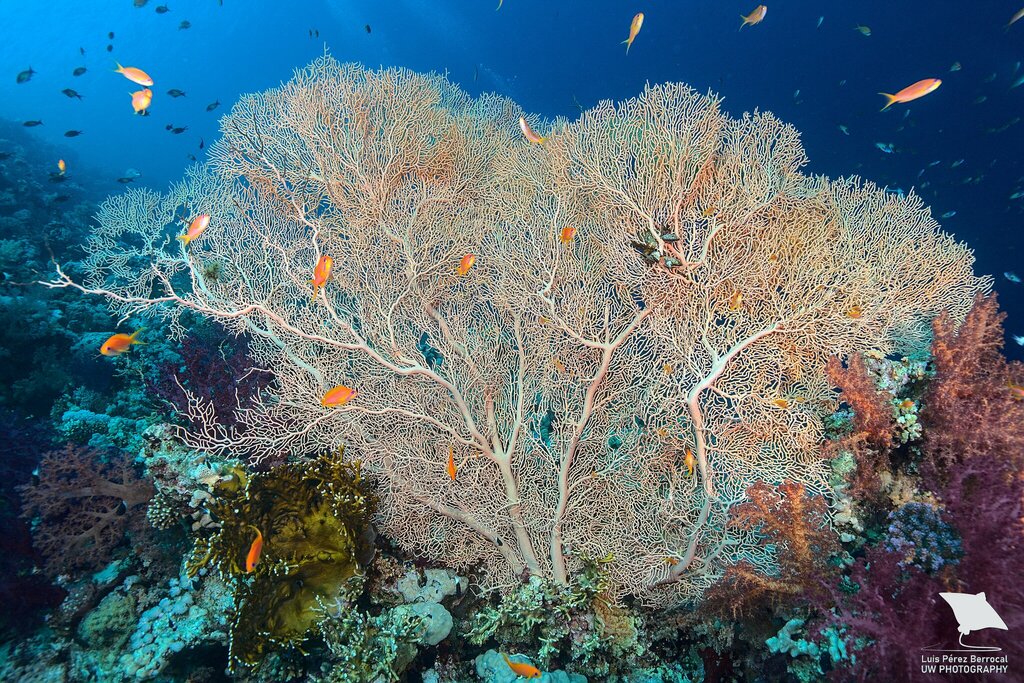
Sea Fans (Gorgonians) in Mauritius — Subergorgia spp.
Few sights in the underwater world rival the elegance of a fully grown sea fan spreading its branching arms across a current-swept reef wall. In Mauritius, the gorgonian corals of the genus Subergorgia — commonly known as sea fans or gorgonian fans — are a defining feature of the island's rich coral ecosystems. Classified within the order Alcyonacea, these colonial organisms are technically soft corals, though their internal skeleton of gorgonin protein gives them a firm, woody structure that can persist for decades.
Identification and Biology
Subergorgia sea fans typically grow in a single, flat plane oriented perpendicular to the prevailing current, maximising their ability to capture passing zooplankton. Their branching network of interconnected polyps forms a distinctive fan or bush shape, often ranging in colour from deep orange and red to purple, yellow, and brown. Each tiny polyp extends eight feathery tentacles to feed, giving the colony a fuzzy, textured appearance when viewed up close. Colonies in Mauritius can reach impressive sizes — some exceeding one metre in diameter — and represent decades of slow, methodical growth at rates of just a few centimetres per year.
Unlike reef-building (hermatypic) corals, sea fans do not rely on photosynthetic zooxanthellae for nutrition, which means they thrive at greater depths where sunlight is limited. In Mauritius, they are most commonly found between 15 and 40 metres, clinging to vertical walls, overhangs, and rocky pinnacles where current flow is strong and consistent.
Role in the Reef Ecosystem
Sea fans are far more than decorative structures on the reef. Their complex branching architecture provides vital habitat for a remarkable diversity of marine life. Pygmy seahorses, basket stars, brittle stars, and numerous species of gobies and clingfish use gorgonian fans as both shelter and hunting grounds. Featherstars (crinoids) frequently drape themselves over sea fan branches to take advantage of the elevated feeding position. In this way, a single large Subergorgia colony can serve as a micro-ecosystem supporting dozens of associated species simultaneously.
Gorgonians also play an important role in water column filtration. Their vast networks of polyps remove significant quantities of microscopic organic particles from the water, contributing to overall reef water clarity and quality.
Where to Find Sea Fans in Mauritius
Mauritius is blessed with a diverse range of dive environments — from shallow lagoons protected by fringing reefs to dramatic outer reef drop-offs and volcanic rock formations — and sea fans can be found across many of these habitats. The island's south and east coasts, where stronger currents sweep along the reef walls, are particularly productive for gorgonian encounters. Sites around the north and northwest also host impressive colonies at depth.
Look for them on the vertical faces of reef walls and at the edges of coral plateaus where water movement accelerates. During drift dives along current-exposed channels, it is common to see large Subergorgia fans lined up in spectacular rows, each one facing into the flow like a sail catching the wind.
Conservation and Responsible Diving
Despite their robust appearance, sea fans are surprisingly fragile ecosystems. Careless fin kicks, accidental contact by divers, and anchor damage can break branches that took years to grow. Climate change poses a longer-term threat through ocean warming and acidification, both of which can stress and bleach gorgonian colonies. In Mauritius, these corals are protected under national marine legislation, and all responsible dive operators follow strict no-touch policies around coral formations.
When diving near sea fans, maintain excellent buoyancy control, keep fins well clear of the reef, and avoid using sea fans as anchor points for photographs. Your restraint helps ensure these magnificent organisms continue to thrive for generations of divers to come.
Photography Tips
Sea fans are outstanding photographic subjects. Use a wide-angle lens to capture the full sweep of a large colony with a diver for scale, or switch to a macro lens to reveal the extraordinary detail of individual polyps and their tiny resident organisms. Early morning dives often yield the best visibility and most extended polyp feeding activity.