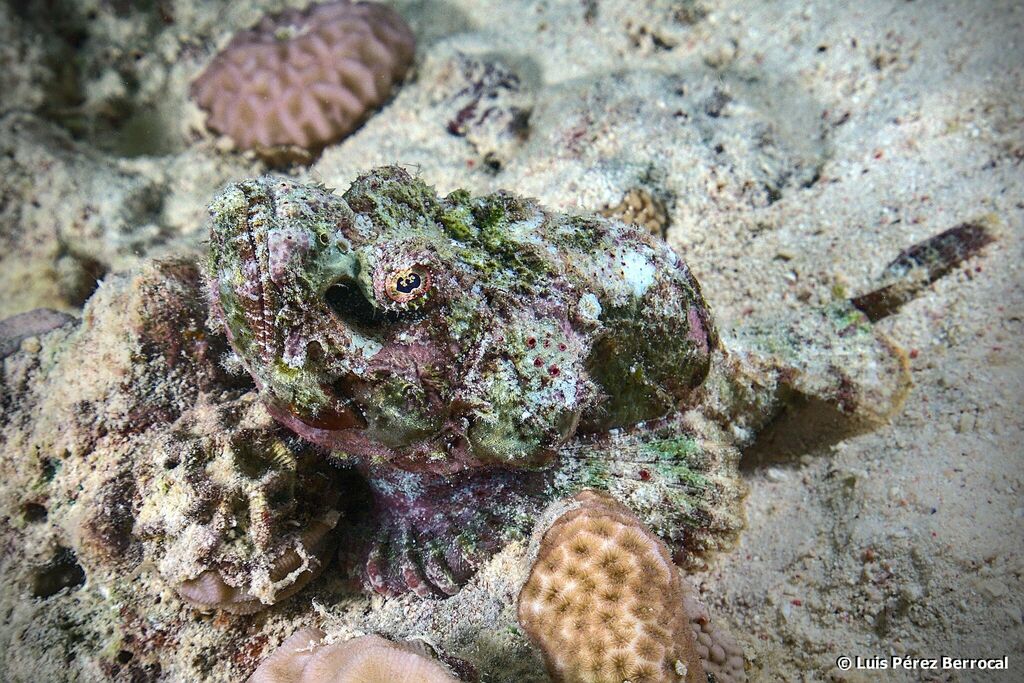
Scorpionfish in Mauritius: The Reef's Master of Disguise
The Scorpionfish, known locally as Poisson scorpion and scientifically as Scorpaenopsis diabolus, is one of the most fascinating — and most commonly overlooked — residents of Mauritius's coral reefs. Belonging to the family Scorpaenidae, this species has perfected the art of camouflage to a degree that rivals any creature in the Indian Ocean. Its lumpy, textured body, adorned with irregular patches of red, brown, orange, and grey, blends seamlessly with algae-covered rock, dead coral, and rubble zones across the island's dive sites.
Identification and Physical Characteristics
Growing to around 30 centimetres in length, Scorpaenopsis diabolus — the Devil Scorpionfish — is a stocky, broad-headed fish with a dramatically humped back profile that is one of its key identifying features. Its face is almost grotesque in beauty: a wide, downturned mouth, heavily ridged brow, and eyes that swivel independently to track prey. When threatened or during courtship, the scorpionfish will flash the underside of its pectoral fins, revealing vivid yellow, orange, and black colouration — a sudden burst of warning colour that is quite startling against its otherwise drab exterior. The dorsal spines are hollow and connected to venom glands, making this fish potentially dangerous to unwary divers or snorkellers who accidentally make contact.
Behaviour and Hunting Strategy
The scorpionfish is a textbook ambush predator. Rather than actively chasing prey, it relies almost entirely on patience and its remarkable camouflage. It selects a position on the reef — often near the base of a coral head, on rubble, or resting on a ledge — and waits, sometimes for hours, for a small fish or crustacean to venture within striking range. When prey comes close enough, the scorpionfish strikes with explosive speed, engulfing the victim in a single rapid lunge. This sedentary lifestyle means divers can observe them at leisure once spotted, making them a favourite subject for underwater photographers in Mauritius.
Habitat in Mauritius
In Mauritius, Scorpaenopsis diabolus is found throughout the lagoon and along the outer reef slopes, typically at depths between 3 and 40 metres. They are particularly fond of mixed rubble and coral habitats, reef edges, and sandy patches adjacent to coral structures. Both sheltered lagoon sites and more exposed outer reef walls host resident populations. Dive sites around the west and north coasts of the island — where reef diversity is highest — offer particularly reliable sightings.
Diving with Scorpionfish: Safety Tips
While the scorpionfish's venom is rarely life-threatening to healthy adults, a sting from its dorsal spines is intensely painful and requires immediate medical attention. The golden rule is never touch the reef — not only does this protect the coral, it protects you from accidental contact with a well-camouflaged scorpionfish. Wearing dive boots and being mindful of where you place your hands and knees underwater are simple precautions that greatly reduce risk. Divers should also be careful not to kneel on rubble patches, a favourite resting spot for this species.
Photography Tips
Scorpionfish are a dream subject for macro and wide-angle underwater photographers alike. Approach slowly and horizontally to avoid startling the fish — though they rarely flee, they may shift position. Use a torch or dive light to illuminate the rich textures and colours of the skin. Shooting from a slight angle can help reveal the characteristic hump profile that distinguishes this species. Many Mauritian dive guides are expert at spotting scorpionfish and will happily point them out during guided dives.
Ecological Role
As mid-level predators, scorpionfish play an important role in maintaining the balance of reef ecosystems in Mauritius. By controlling populations of small reef fish and invertebrates, they contribute to the overall health and biodiversity of the coral communities that make Mauritian waters so globally celebrated.