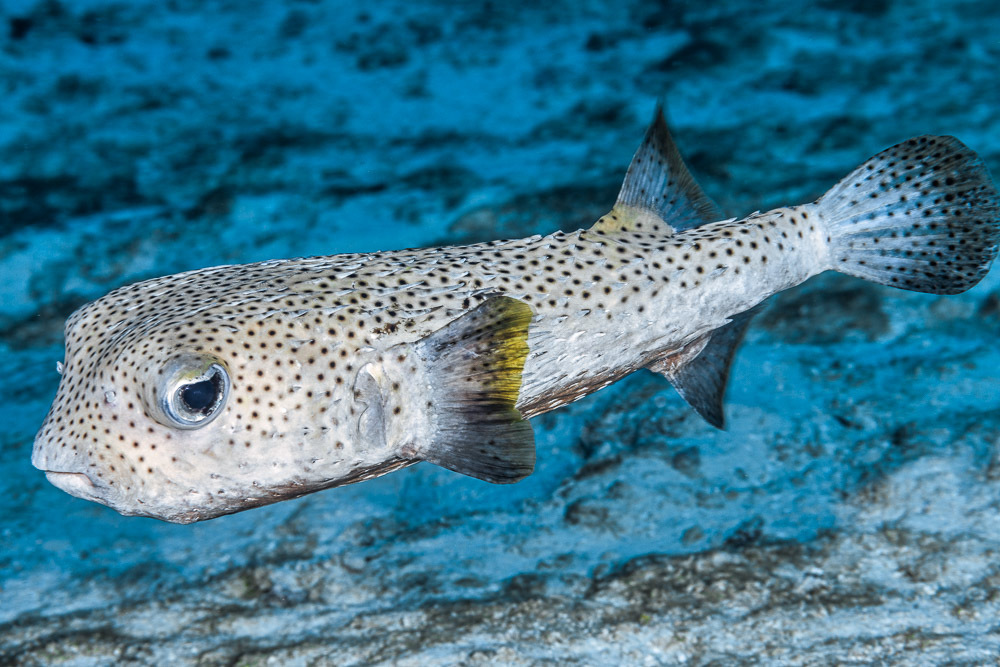
Porcupinefish in Mauritius: The Spiny Jewel of the Reef
The Porcupinefish (Diodon hystrix), locally known as Poisson porc-épic, is one of the most distinctive and charming residents of Mauritius's coral reefs. With its oversized eyes, beak-like fused teeth, and a body studded with long, sharp spines, this species is instantly recognisable and consistently ranks among divers' favourite encounters in the Indian Ocean.
Appearance and Biology
Diodon hystrix belongs to the family Diodontidae and can grow up to 90 centimetres in length, though most individuals encountered on Mauritian reefs range between 30 and 60 cm. The body is tan to olive-brown, covered in dark spots, and — most notably — armed with long, erectile spines that lie flat when the fish is calm. When threatened, the Porcupinefish inflates its body by rapidly swallowing water, erecting its spines into a formidable defensive globe that deters almost any predator.
Unlike many reef fish, the Porcupinefish has a slow, undulating swimming style powered by its pectoral fins, giving it an almost comical, waddling appearance that divers find endearing. Its large, forward-facing eyes give it excellent binocular vision — a key adaptation for hunting prey in low-light conditions.
Diet and Behaviour
Porcupinefish are primarily nocturnal hunters, feeding on hard-shelled invertebrates such as sea urchins, molluscs, hermit crabs, and snails. Their fused, beak-like teeth are powerful enough to crush the shells of these prey items with ease. During the day, they are often found resting quietly in coral caves, under ledges, or hovering lazily near the reef — making them relatively easy to approach and observe on daytime dives.
Despite their slow, seemingly docile nature, Porcupinefish are solitary and can be mildly territorial. They are not aggressive toward divers, but it is important never to startle or touch them — stressing the fish into inflating wastes valuable energy and can cause harm over time.
Where to See Porcupinefish in Mauritius
Porcupinefish are common throughout the reefs of Mauritius, found in both shallow lagoon areas and deeper reef walls down to around 50 metres. They are particularly fond of sheltered overhangs, coral caves, and areas with rich invertebrate life. Some of the best dive sites to encounter them include the sheltered reefs of Blue Bay Marine Park, the dramatic walls of Cathedral near Flic en Flac, and the rich coral gardens of Trou aux Biches on the northwest coast.
Snorkelling and Diving Tips
- Approach slowly and calmly — Porcupinefish are not shy, but sudden movements will cause them to retreat.
- Look under coral overhangs and in cave entrances during the day — this is where they rest.
- For the best chance of seeing them active and feeding, consider a night dive on any Mauritian reef.
- Maintain a respectful distance and never attempt to provoke inflation — it is harmful to the fish and considered poor diving etiquette.
Conservation Status and Importance
While Diodon hystrix is currently listed as Least Concern on the IUCN Red List, Porcupinefish face threats from habitat degradation, coral bleaching, and accidental capture in fishing nets. In Mauritius, marine protected areas such as Blue Bay Marine Park play a crucial role in safeguarding reef ecosystems that these fish depend upon. As a diver or snorkeller, you can contribute to their conservation by following responsible underwater guidelines, supporting local marine protection initiatives, and reporting any unusual or concerning sightings to local authorities.
The Porcupinefish is not just a photogenic reef resident — it plays an important ecological role in controlling sea urchin and mollusc populations, helping to maintain the balance of healthy coral reef ecosystems. Protecting Mauritius's reefs means protecting these remarkable creatures for generations of divers to come.