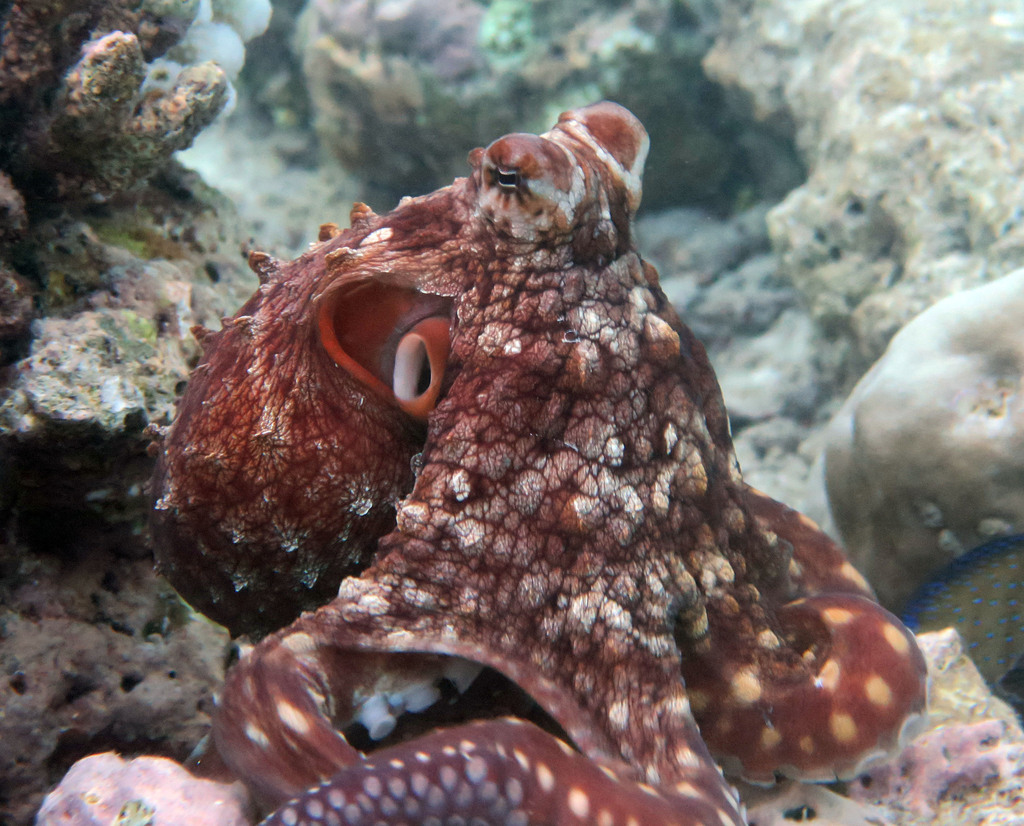
Reef Octopus in Mauritius — Octopus cyanea
Among the most intelligent and mesmerising invertebrates inhabiting Mauritius's coral reefs, the reef octopus (Octopus cyanea) — known locally as the Poulpe de récif — is a firm favourite for divers and snorkellers exploring the island's protected lagoons and outer reef walls. With eight sinuous arms, remarkable problem-solving ability, and an almost supernatural talent for disguise, this species is a jewel of the Indian Ocean's underwater world.
Identification
Octopus cyanea is one of the largest shallow-water octopus species in the Indo-Pacific. Adults commonly reach a mantle length of 16 cm, with arm spans stretching up to 80 cm or more. The defining feature that gives the species its common name — the day octopus — is its diurnal activity; unlike many octopus species that hunt at night, the reef octopus is frequently active during daylight hours, making it highly visible to snorkellers and scuba divers alike.
Its most striking visual trait is a large, dark ocellus (eye-spot) on each side of the mantle, used to startle predators. The body colour shifts constantly — from sandy beige and mottled brown to deep red or pale white — as the octopus manipulates thousands of pigment-filled cells called chromatophores to blend seamlessly with its surroundings. The skin texture can also ripple from smooth to heavily papillate in less than a second, completing its extraordinary camouflage toolkit.
Behaviour and Ecology
The reef octopus is an active and opportunistic predator, hunting crustaceans, molluscs, and small fish across the reef during the day. It employs a fascinating hunting technique — spreading its webbed arms like a parachute over the seafloor to trap prey beneath, then subduing it with a venomous bite delivered by its parrot-like beak. After feeding, it often returns to a preferred den — a crevice in the coral or a hollow beneath a rock — identifiable by the neat pile of discarded crab and mollusc shells at the entrance, known as a midden.
Intelligence is one of the hallmarks of this species. Reef octopuses have been observed using coconut shell halves and other debris as portable shelters, demonstrating tool use — a behaviour once thought exclusive to vertebrates. They are also capable of learning and memorising the layout of their home territory on the reef.
Spotting Reef Octopus in Mauritius
Mauritius offers exceptional conditions for observing Octopus cyanea. The species is common throughout the island's fringing reefs, lagoons, and outer reef slopes, typically found at depths ranging from 1 m to 40 m. The calm, warm, and clear waters of the Mauritian lagoon — particularly on the western and northern coastlines — provide ideal habitat.
Look for the telltale midden of shells near coral overhangs and boulder formations. A patient diver who approaches slowly and avoids sudden movements is often rewarded with prolonged observation as the octopus curiously investigates its visitor rather than retreating. Snorkellers exploring shallow reef flats, especially in Blue Bay Marine Park, frequently encounter foraging individuals in as little as one to three metres of water.
Conservation and Responsible Interaction
While Octopus cyanea is currently classified as a species of Least Concern by the IUCN, it faces pressure in Mauritius from artisanal fishing, where it is a valued food source and an important part of the local fishing economy. Sustainable harvesting practices and the protection afforded by marine parks such as Blue Bay are critical for maintaining healthy populations.
As a diver or snorkeller, always observe reef octopuses without touching or harassing them. Never attempt to pull them from their dens, as this causes extreme stress. Responsible wildlife interaction ensures these extraordinary animals remain a highlight of Mauritian reef diving for generations to come.