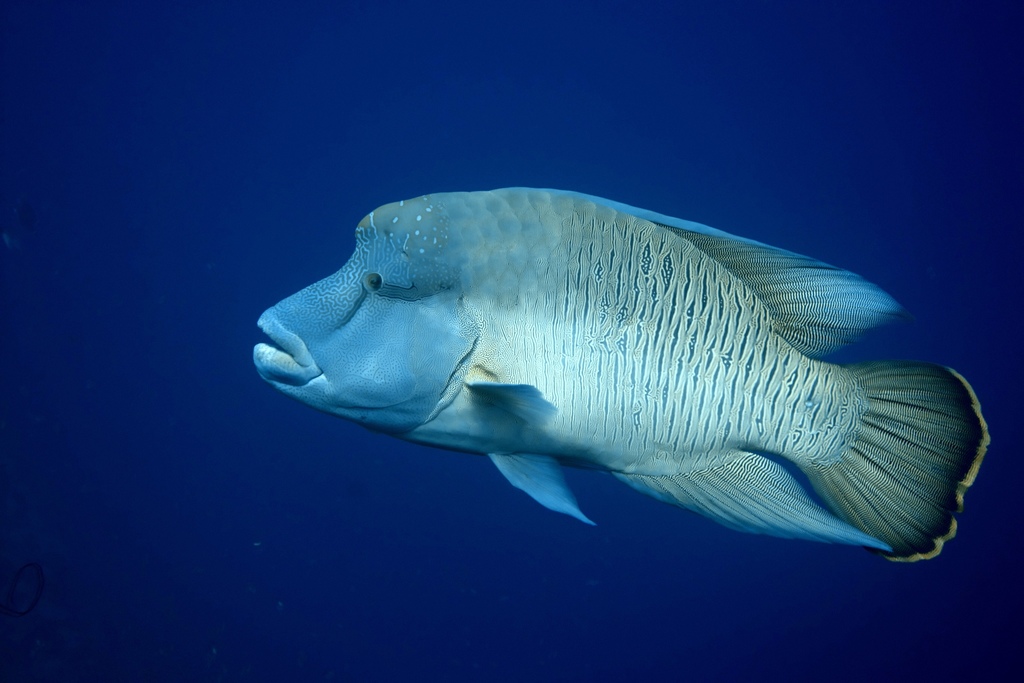
Napoleon Wrasse in Mauritius — The King of the Reef
Few marine encounters rival the sheer grandeur of coming face to face with a Napoleon wrasse (Cheilinus undulatus), also known as the humphead wrasse. Named locally as Napoléon, this magnificent fish is the largest member of the wrasse family and one of the most iconic species on any tropical reef. In Mauritius, it is classified as rare, making every sighting an unforgettable privilege for divers who venture into the island's most pristine underwater ecosystems.
Identification: Hard to Miss, Impossible to Forget
The Napoleon wrasse is unmistakable. Adults can reach up to 2 metres in length and weigh as much as 190 kilograms, making them the undisputed heavyweights of the coral reef. Their most distinctive feature is the pronounced hump on the forehead, which becomes more pronounced with age. The body displays a rich palette of blue-green and turquoise hues, with intricate maze-like markings etched across the scales. Thick, fleshy lips give the fish a somewhat regal, almost contemplative expression — perfectly befitting their slow, unhurried movements through the water.
Juvenile Napoleon wrasse look quite different from adults, displaying pale colouration with dark-edged scales, and are far less commonly spotted in Mauritian waters. The adults you're likely to encounter here are often solitary, patrolling reef edges and drop-offs with quiet authority.
Behaviour and Ecology
Napoleon wrasse are diurnal predators, actively feeding during the day on a wide variety of prey. They are one of the few fish capable of eating toxic prey such as sea hares, boxfish, and even crown-of-thorns starfish — making them an ecologically vital species for reef health. Their powerful jaws and strong teeth allow them to crush hard-shelled molluscs, crustaceans, and echinoderms with ease.
In Mauritius, they tend to inhabit deeper reef zones, outer slopes, and channel passages where strong currents bring nutrient-rich waters. They are not territorial in the traditional sense but are known to return to the same areas of reef, giving knowledgeable local dive guides the best chance of locating them. Napoleon wrasse are also known to be surprisingly curious and approachable when not pressured — a relaxed diver maintaining distance may be rewarded with a prolonged, close encounter.
Conservation Status and Threats
The Napoleon wrasse is listed as Endangered on the IUCN Red List, and its global population has declined significantly due to overfishing — particularly for the live reef fish food trade in Southeast Asia, where it commands extraordinarily high prices. Their slow growth rate and late sexual maturity (they don't reproduce until around 5–7 years of age) make population recovery extremely slow.
In Mauritius, the species is legally protected, and local marine conservation efforts are working to preserve critical reef habitats. Responsible diving practices — maintaining distance, never chasing or cornering the fish, and avoiding touching the reef — are essential to ensuring this species continues to visit Mauritian waters. Divers and snorkellers play a direct role in conservation by supporting eco-conscious dive operators and reporting sightings to local marine authorities.
Best Conditions for Spotting Napoleon Wrasse
Sightings in Mauritius are most commonly reported at deeper dive sites along the outer reef, particularly in areas with strong tidal flow and abundant reef fish life. Early morning dives, when fish are most active before boat traffic increases, tend to yield the best results. Visibility in Mauritius regularly exceeds 20–30 metres, which is ideal for spotting large pelagic reef fish approaching from the blue.
Patience, a slow descent, and a calm underwater demeanour are your greatest assets. The Napoleon wrasse is a creature of habit — if one has been seen at a site before, there's a reasonable chance it will return. Trust your dive guide, stay neutrally buoyant, and let the ocean do the rest.