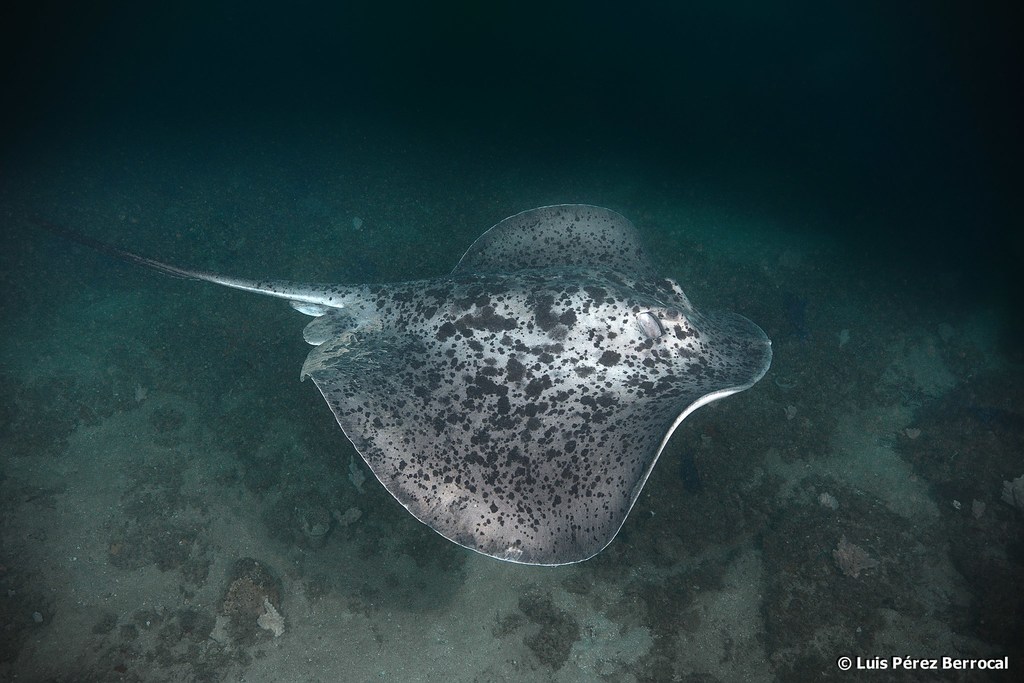
Marbled Stingray in Mauritius – A Diver's Guide to Taeniura meyeni
The Marbled Stingray, known scientifically as Taeniura meyeni and locally as Raie Marbrée, is one of the most visually striking rays found in Mauritian waters. Belonging to the family Dasyatidae, this species is distinguished by its large, rounded pectoral disc adorned with a beautiful marbled pattern of black, grey, and white — a natural camouflage that makes it both elusive and spectacular when spotted against the sandy ocean floor.
Physical Characteristics
The Marbled Stingray is a large species, with disc widths commonly reaching 1.5 to 1.8 metres, and some individuals exceeding 2 metres. Its tail is notably long and whip-like, featuring one or two venomous spines used exclusively for defence. Unlike some other stingray species, Taeniura meyeni has no dorsal or caudal fins, giving it a clean, elegant silhouette as it moves through the water. The underside is white, providing a striking contrast to the intricate dorsal patterning that gives this species its common name.
Behaviour and Ecology
In Mauritius, Marbled Stingrays are most commonly encountered resting motionless on sandy patches between coral formations, partially buried under a light dusting of sand. They are bottom-dwellers that feed primarily on molluscs, crustaceans, and small bony fish, which they excavate from the substrate using their flattened bodies and strong jaws. Despite their size, they are generally docile and non-aggressive towards divers, often allowing close observation when approached slowly and calmly.
These rays are ovoviviparous, meaning the females carry their eggs internally until they hatch, giving birth to live young. Litters are typically small, consisting of one to seven pups. This slow reproductive rate makes the species particularly vulnerable to overfishing and habitat degradation.
Where to See Marbled Stingrays in Mauritius
Mauritius offers exceptional conditions for encounters with this magnificent ray. The island's lagoons, passes, and outer reef slopes provide ideal habitat — sandy corridors flanked by healthy coral gardens are prime territory. Some of the most reliable dive sites include the famous Blue Bay Marine Park, the dramatic walls of Coin de Mire, and the sandy channels of Rodrigues Island. The southwestern coast around Le Morne is another hotspot, where divers regularly report sightings during morning dives when the rays are most active.
Divers should approach these animals with patience and respect — hovering neutrally at a distance and allowing the ray to become comfortable with your presence. Never attempt to ride or touch a stingray, as this causes stress and could result in a defensive tail strike.
Best Season for Sightings
While Marbled Stingrays can be seen year-round in Mauritius thanks to the island's warm tropical waters, sightings are most frequent between October and April — the austral summer. During this period, water temperatures range from 27°C to 30°C and visibility is typically excellent, often exceeding 25 metres. The calmer seas of the lagoon season make boat access to outer dive sites much easier, increasing your chances of a meaningful encounter.
Conservation Status and Threats
The Marbled Stingray is currently classified as Vulnerable on the IUCN Red List. Its slow growth rate and low reproductive output make populations slow to recover from anthropogenic pressures. In the Indian Ocean region, the main threats include targeted fishing for meat and liver oil, incidental bycatch in trawl and longline fisheries, and coral reef degradation. In Mauritius, the species benefits from protections within marine park zones, but continued vigilance and responsible ecotourism practices are essential to ensure these rays remain a common sight for future generations of divers.
Tips for Divers
- Maintain neutral buoyancy and approach slowly from the front to avoid startling the ray.
- Keep noise and sudden movements to a minimum — these rays are sensitive to vibration.
- Dive during morning hours when stingrays are more likely to be active and feeding.
- Choose a certified local dive operator familiar with Marbled Stingray behaviour and conservation best practices.