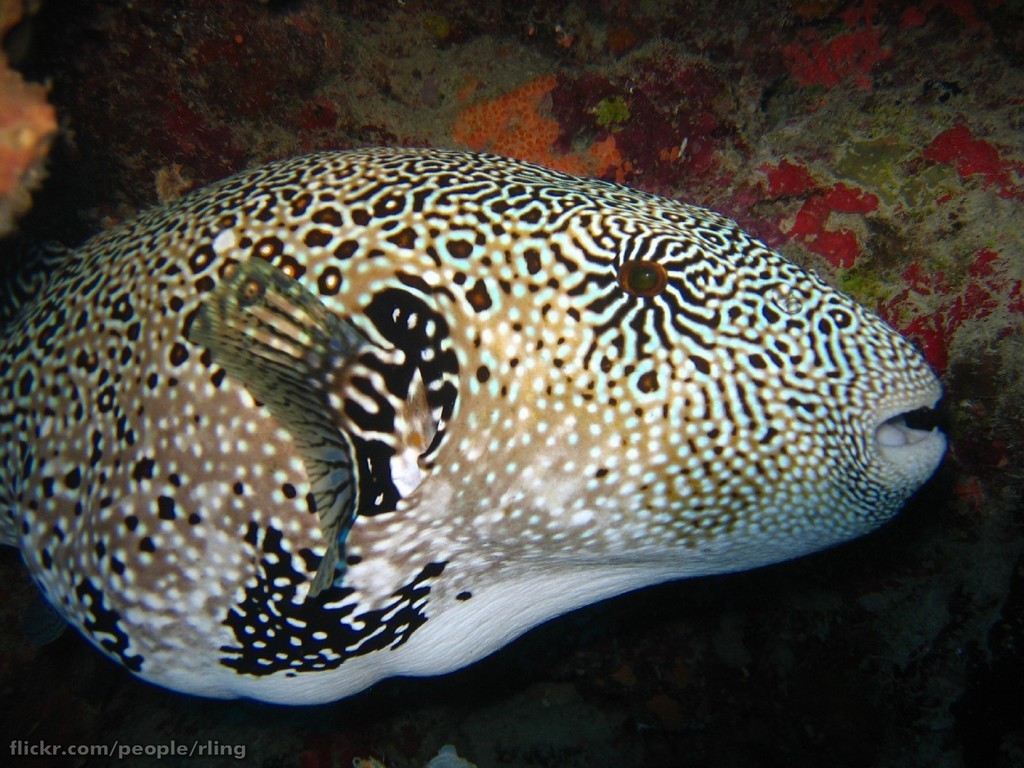
Map Pufferfish in Mauritius — Arothron mappa
The Map Pufferfish (Arothron mappa), known in French as the Poisson ballon carte, is one of the most distinctive and beloved reef fish encountered by divers and snorkelers in Mauritius. A member of the family Tetraodontidae, this large, rotund fish is instantly recognisable by its intricate network of pale lines and markings that criss-cross its creamy-white to yellowish body — patterns so elaborate and maze-like that early naturalists likened them to the contour lines of a topographical map.
Appearance and Size
Growing up to 65 centimetres in length, the Map Pufferfish is one of the larger pufferfish species found on Indo-Pacific reefs. Its body is robust and oval-shaped, lacking the scales and pelvic fins typical of most fish. The skin is thick and slightly rubbery, covered in small spines that become visible when the fish inflates itself as a defence mechanism. The striking maze-like pattern on its body, combined with a vivid yellow ring encircling its eyes and a dark blotch near the pectoral fins, makes identification straightforward even for beginner divers. Its small, beak-like mouth — formed from fused teeth — is powerful enough to crunch through hard corals and invertebrates.
Behaviour and Diet
Map Pufferfish are generally solitary and slow-moving, spending their days patrolling reef edges, sandy channels, and coral gardens in search of food. Their diet is varied and opportunistic, encompassing hard corals, sponges, molluscs, crustaceans, and tunicates. They are most active during the day and tend to seek shelter in crevices and overhangs as night approaches.
Like all pufferfish, Arothron mappa possesses the remarkable ability to rapidly inflate its body by ingesting water, transforming itself into a spiky, almost spherical ball to deter predators. Despite this defence, they are generally unhurried and inquisitive around divers, often pausing to observe their human visitors with large, expressive eyes. It is important, however, to maintain a respectful distance and never provoke or chase a pufferfish, as stress can harm the animal.
It is worth noting that Map Pufferfish, like all members of their family, contain tetrodotoxin — a potent neurotoxin concentrated primarily in the liver, skin, and gonads. This chemical defence renders them unpalatable and dangerous to most predators, and means they should never be handled or consumed.
Habitat in Mauritius
In Mauritius, the Map Pufferfish is considered a common species on healthy reef systems, found at depths ranging from the shallows down to around 30 metres. They favour areas with rich coral coverage, rocky outcrops, and rubble zones where their food sources are abundant. The island's protected lagoons, outer reef walls, and volcanic rock formations all provide ideal habitat for this species.
Best Dive Sites to See Map Pufferfish in Mauritius
Some of the most reliable locations to encounter Map Pufferfish in Mauritius include the famous Blue Bay Marine Park in the south-east, where crystal-clear waters and dense coral gardens create perfect conditions. The reefs off Flic en Flac on the west coast are another hotspot, offering excellent visibility and a wealth of reef life. Coin de Mire in the north, Stella Maris, and the offshore sites around Grand Baie are also well-known locations where divers regularly photograph this charismatic species.
Tips for Divers and Snorkelers
- Move slowly and calmly — Map Pufferfish are more likely to linger if you approach without sudden movements.
- Early morning dives often yield the best sightings as fish are more active.
- Always avoid touching or cornering pufferfish — forced inflation is harmful to the animal.
- A wide-angle lens or macro lens both work well for photographing the intricate body patterns.
Whether you are a seasoned underwater photographer or a first-time snorkeler, an encounter with the Map Pufferfish is guaranteed to be a highlight of your time exploring the magnificent reefs of Mauritius.