Longnose Butterflyfish in Mauritius — A Reef Jewel Worth Seeking
The longnose butterflyfish (Forcipiger flavissimus), known locally in French as poisson papillon à long nez, is one of the most distinctive and beloved fish encountered on the coral reefs surrounding Mauritius. A member of the family Chaetodontidae, this species is celebrated worldwide for its striking appearance and fascinating feeding behaviour, making it a favourite subject for underwater photographers and wildlife enthusiasts alike.
Identification and Appearance
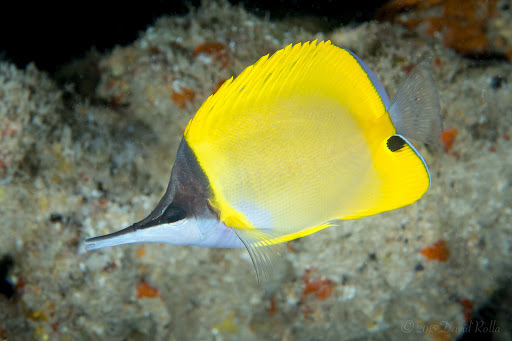
Identifying the longnose butterflyfish is a joy — there is very little room for confusion. Its body is almost entirely brilliant canary yellow, a colour that stands out vividly against the blues and greens of the Indian Ocean reef. The upper portion of the head is dark brown to black, while the lower portion is white, giving the face a two-toned, almost masked appearance. A small but noticeable false eyespot near the tail helps confuse predators about which end is which. Most striking of all is its extraordinary elongated snout, which can account for nearly one-third of the fish's total body length. Adults typically reach between 15 and 22 centimetres in length.
This species can occasionally be confused with the very similar Forcipiger longirostris (the big longnose butterflyfish), which has an even longer snout, but F. flavissimus is by far the more commonly encountered of the two on Mauritian reefs.
Behaviour and Feeding
The longnose butterflyfish's remarkable snout is no accident of evolution — it is a precision feeding tool. Using the fine, brush-like teeth at the tip of its jaw, this fish extracts small invertebrates, hydroids, tube worm tentacles, and fish eggs from deep within coral branches and rocky crevices that would be completely inaccessible to most other reef inhabitants. This dietary specialisation means the longnose butterflyfish rarely competes directly with other butterflyfish species, allowing it to coexist peacefully on diverse reefs.
You will most often see longnose butterflyfish swimming in pairs or small groups, as they are believed to form monogamous bonds during the breeding season. They tend to stay within defined home territories on the reef, which makes finding them again on repeated dives quite predictable once you know where to look.
Habitat in Mauritius
In Mauritian waters, the longnose butterflyfish is classified as common and is found across a wide range of reef environments. It shows a preference for outer reef slopes, drop-offs, and areas with rich coral growth, particularly where branching corals such as Acropora species are abundant. It is typically found at depths ranging from 2 metres in lagoon shallows all the way down to 70 metres or more, though divers most frequently encounter it between 5 and 30 metres.
Mauritius offers exceptional reef habitats on all sides of the island, and the longnose butterflyfish takes full advantage of this diversity. The protected lagoons of the west and south coasts provide sheltered feeding grounds, while the more exposed northern reefs offer dramatic drop-offs where pairs of these fish can be seen picking daintily at coral structures.
Underwater Photography Tips
The longnose butterflyfish is a rewarding photographic subject thanks to its vivid colouration and relatively approachable nature. Move slowly and deliberately when approaching, avoiding sudden movements. A macro or wide-angle lens can both work well depending on whether you wish to capture the detail of the snout or the fish in its full reef context. Early morning dives often yield the most active feeding behaviour, offering excellent opportunities to document the snout in action.
Ecological Importance
As with all butterflyfish, the longnose acts as an important indicator species for reef health. Its presence in healthy numbers on Mauritian reefs is a positive sign of ecosystem balance and sufficient coral cover. Conservation-minded divers are encouraged to respect no-touch policies and avoid disturbing coral structures that these fish depend on for feeding and shelter.