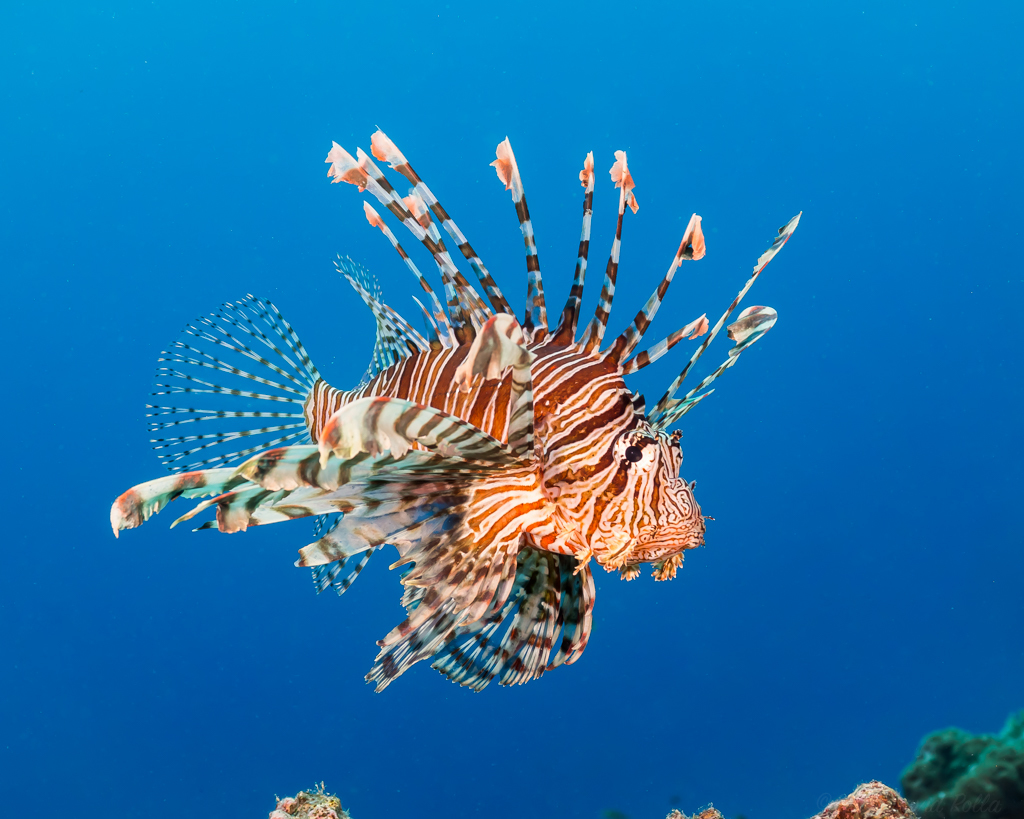
Lionfish in Mauritius: The Ocean's Most Beautiful Predator
The lionfish (Pterois volitans), known locally as poisson lion or rascasse volante, is one of the most recognisable and frequently encountered reef fish in Mauritius. Found throughout the Indo-Pacific, this species thrives in the warm, clear waters surrounding the island, inhabiting coral reefs, rocky outcrops, and lagoon walls from shallow snorkelling zones down to depths of 50 metres or more.
Identification: Unmistakable in Any Ocean
Few fish are as easy to identify as the lionfish. Its body is adorned with alternating bands of rich red, white, and brown, while its oversized pectoral fins spread outward like a pair of ornate fans. Long, feather-like dorsal spines extend dramatically above its back, giving it the appearance of a creature from another world. Adults typically measure between 30 and 40 centimetres in length, though larger individuals can reach up to 47 cm. Their large, upward-tilting mouths are perfectly designed for ambush predation — opening rapidly to create a powerful suction that draws in small fish and crustaceans in a fraction of a second.
Behaviour and Hunting Strategy
Despite their spectacular appearance, lionfish are masters of stealth. During the day, they often rest motionlessly beneath coral ledges, inside caves, or beside sponges, relying on their cryptic patterning to blend into the reef environment. At dusk and dawn, they become highly active hunters, using their wide pectoral fins to slowly herd small prey fish into corners before striking with lightning speed. This behaviour makes them fascinating to observe during twilight dives in Mauritius, where they can sometimes be seen corralling prey along the reef edge.
The Venom: Beautiful but Dangerous
The lionfish's dorsal, pelvic, and anal spines are all venomous. While a sting is rarely fatal to healthy adults, it causes intense, immediate pain, swelling, and in some cases nausea or temporary paralysis. Divers and snorkellers should always maintain a respectful distance and never attempt to touch or handle lionfish. If stung, immersing the affected area in hot (but not scalding) water helps to break down the protein-based venom. Seek medical attention promptly if symptoms persist.
Role on the Reef
In their native Indo-Pacific range — including Mauritius — lionfish play an important ecological role as mid-level predators, helping to regulate populations of small reef fish and invertebrates. Unlike in the Atlantic and Caribbean, where lionfish are an invasive species causing significant ecological damage, Mauritian reefs have natural predators and parasites that keep lionfish populations in check. Reef sharks, large groupers, and moray eels are known to prey on lionfish, maintaining a natural balance in the ecosystem.
Where to See Lionfish in Mauritius
Lionfish are common on Mauritian reefs year-round and can be spotted at virtually every dive site around the island. They particularly favour sites with complex coral structures, rocky overhangs, and caverns where they can rest undisturbed during daylight hours. Dive sites such as Flic en Flac, Coin de Mire, and the wrecks of the Stella Maru and Kei Sei 113 are especially productive spots. Wreck dives are particularly rewarding, as lionfish frequently colonise the dark interiors and encrusted exteriors of sunken vessels.
Photography Tips
For underwater photographers, the lionfish is an exceptional subject. Approach slowly and from below to avoid startling the fish, and use a wide-angle lens to capture the full spread of its pectoral fins. A macro lens works beautifully for close-up detail shots of the intricate spine structure and vivid colouration. Early morning and late afternoon dives offer the best light and the highest chance of catching a lionfish in active hunting mode.
Whether you're a seasoned diver or on your first open-water dive, encountering a lionfish on a Mauritius reef is an unforgettable experience — a reminder that the ocean's most spectacular creatures are often its most formidable.