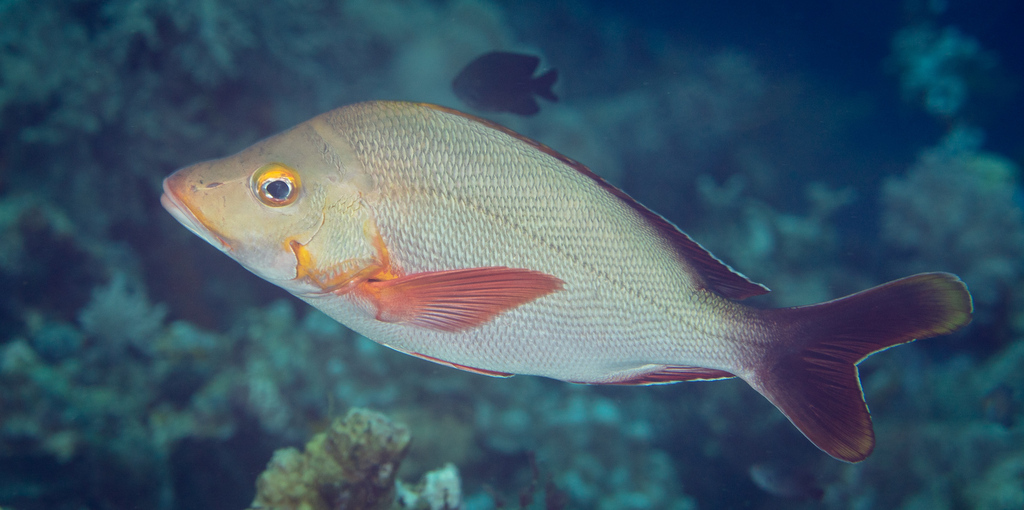
Humpback Red Snapper in Mauritius — Lutjanus gibbus
The Humpback Red Snapper (Lutjanus gibbus), locally known as the Vivaneau bossu, is one of the most commonly encountered medium reef fish throughout Mauritian waters. A member of the family Lutjanidae, this species is celebrated by divers for its vibrant colouration and its tendency to gather in impressive schools around coral reef structures, making it a visually spectacular and ecologically important fish of the Indo-Pacific region.
Identification and Physical Characteristics
True to its name, the Humpback Red Snapper displays a noticeably elevated dorsal profile just behind the head, giving the fish its characteristic "humped" silhouette. Adults typically reach between 30 and 50 centimetres in length, though larger individuals of up to 60 cm have been recorded. The body is predominantly pinkish-red to crimson, often with lighter, almost silvery tones along the belly. The tail is distinctly forked and often displays a darker margin, a reliable identification feature when viewed underwater. Juveniles may present slightly different colouration, appearing more muted with faint lateral markings that fade as the fish matures.
Behaviour and Ecology
One of the most captivating aspects of the Humpback Red Snapper is its highly social nature. These fish are almost always observed in large aggregations, sometimes numbering in the hundreds, drifting in mid-water above reef structures or resting in the shelter of coral overhangs and ledges during daylight hours. This schooling behaviour is believed to offer protection from predators, and the synchronised movement of a large shoal is a mesmerising sight for any underwater observer.
At dusk and during the night, Lutjanus gibbus transitions into an active nocturnal predator, dispersing across the reef to hunt small fish, crustaceans, and cephalopods. This dual lifestyle — passive schooling by day, active hunting by night — makes them a fascinating species to observe during both day and night dives in Mauritius.
Habitat in Mauritius
In Mauritius, the Humpback Red Snapper is found throughout the island's fringing reef system, typically at depths ranging from 5 to 30 metres. They favour coral-rich environments with plenty of structural complexity — rocky outcrops, coral bommies, and reef walls all serve as preferred daytime refuge sites. The fish is commonly encountered on the west and north coast dive sites, where the protected lagoons and clear waters provide ideal conditions. They are equally present along the outer reef slopes where stronger current brings nutrient-rich water.
Importance to the Reef Ecosystem
As a mid-level predator, the Humpback Red Snapper plays a meaningful role in maintaining the balance of reef ecosystems. By controlling populations of smaller fish and invertebrates, the species helps regulate reef biodiversity. It also serves as prey for larger apex predators such as grouper, sharks, and barracuda, placing it at an important intersection within the marine food web around Mauritius.
Fishing and Human Interaction
The Vivaneau bossu is a commercially and recreationally important fish species in Mauritius. It is commonly targeted by local fishermen due to its accessible reef habitat and desirable flesh quality. It is frequently found in local fish markets and restaurants across the island, where it is enjoyed as part of the traditional Mauritian seafood cuisine. While current populations appear stable in Mauritius, sustainable fishing practices remain important to ensure long-term population health.
Tips for Divers and Snorkellers
- Move slowly and calmly when approaching a school — sudden movements will cause the group to disperse quickly.
- Early morning and late afternoon dives tend to yield the largest aggregations near reef structures.
- Look beneath overhangs and inside coral caves for resting groups during midday dives.
- Bring an underwater camera — the vivid red colouration contrasts beautifully against blue Mauritian waters.