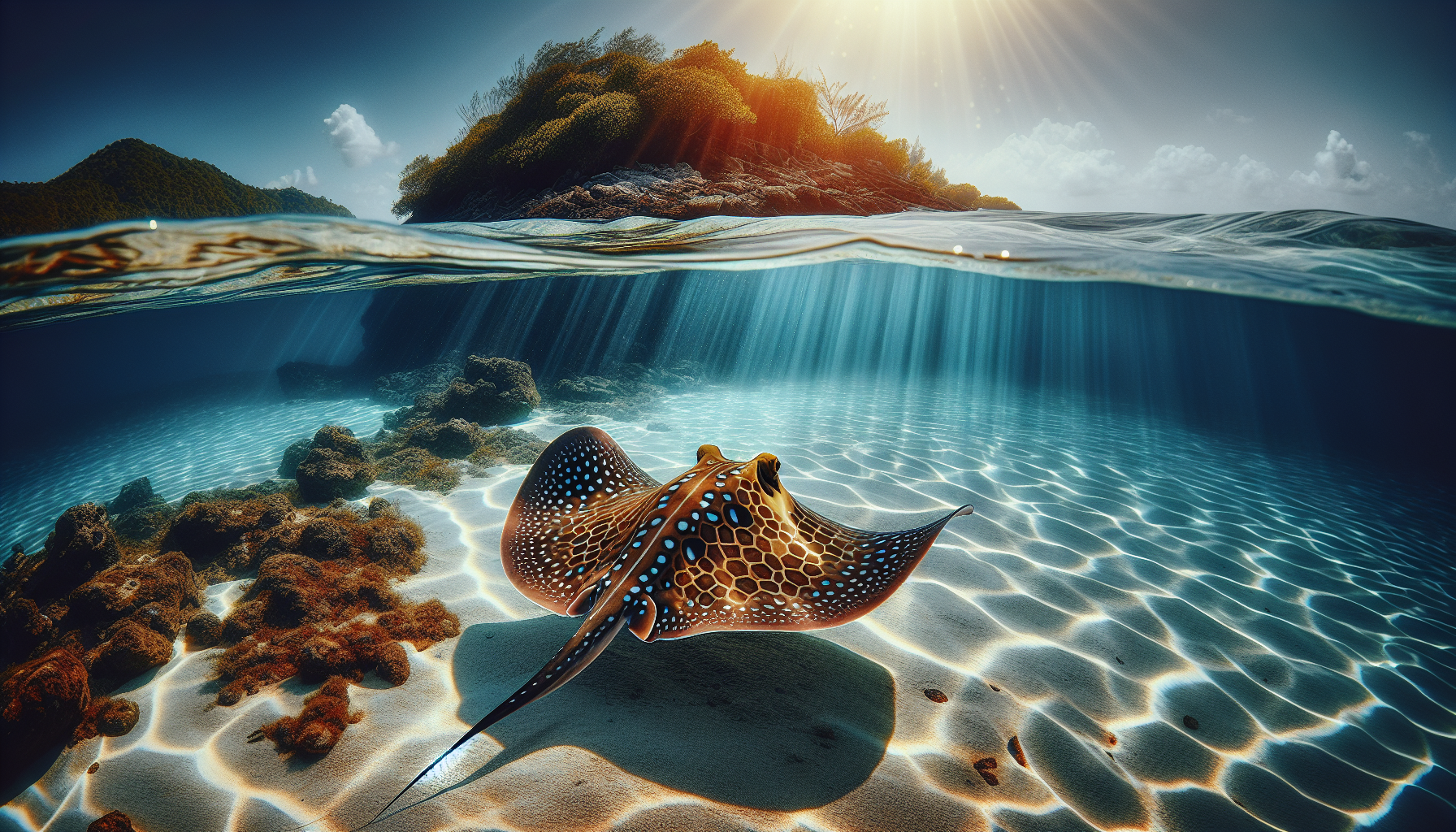
Honeycomb Stingray in Mauritius (Himantura uarnak)
The Honeycomb Stingray, known locally as Raie rayon de miel and scientifically as Himantura uarnak, is one of the most visually distinctive rays found in Mauritian waters. Its broad, diamond-shaped disc is patterned with a beautiful network of pale, honeycomb-like spots set against a dark brown or olive background — a natural camouflage that makes it both stunning and surprisingly hard to spot when resting on the seabed.
Physical Characteristics
The Honeycomb Stingray is a large elasmobranch, with adults commonly reaching disc widths of 100 to 150 cm, and some individuals exceeding 180 cm. The tail is notably long — often two to three times the length of the body disc — and bears one or more venomous serrated spines near its base. Despite its impressive size, this ray moves with effortless elegance, undulating its pectoral fins in a slow, wing-like motion that makes every sighting feel like a ballet performance beneath the waves.
Habitat and Behaviour in Mauritius
In Mauritius, Honeycomb Stingrays are commonly encountered in shallow coastal environments. They favour sandy lagoons, seagrass beds, coral reef flats, and estuarine areas, where they search for food by using their flattened snout to probe the substrate. These rays are primarily benthic feeders, preying on crustaceans, molluscs, worms, and small fish hidden beneath the sand. It is common to observe them partially buried, with only their eyes and spiracles (breathing holes behind the eyes) visible above the sediment.
Honeycomb Stingrays are generally solitary animals, though juveniles may occasionally be seen in loose aggregations in sheltered bays. Adults tend to be more active during early morning and late afternoon, making these the prime times for divers and snorkelers to seek them out. They are generally non-aggressive but should be respected — particularly the tail spine, which can inflict a painful wound if the animal feels threatened or is accidentally stepped upon.
Ecological Role
As mesopredators, Honeycomb Stingrays play a vital role in regulating populations of benthic invertebrates in Mauritius's reef and lagoon ecosystems. Their feeding behaviour also physically disturbs the sediment, contributing to nutrient cycling and creating microhabitats that other species exploit. Like many elasmobranch species, they are viviparous, giving birth to live young, which limits their reproductive rate and makes population recovery slow if populations are impacted.
Diving with Honeycomb Stingrays
Mauritius offers exceptional opportunities to encounter Honeycomb Stingrays in their natural habitat. The calm, warm lagoons on the western and northern coasts are particularly productive, with sites around Flic en Flac, Blue Bay, and Trou aux Biches consistently producing sightings. Snorkelers exploring the inner lagoon at low tide often come across juveniles resting in just a metre or two of water. Scuba divers have the advantage of exploring reef edges and sandy channels where larger adults patrol.
When diving or snorkelling near a Honeycomb Stingray, always maintain a respectful distance, avoid casting shadows over the animal, and never attempt to touch or ride the ray. Responsible observation ensures these magnificent creatures remain undisturbed and that future visitors can enjoy the same privileged encounters.
Conservation
The Honeycomb Stingray is currently listed as Vulnerable on the IUCN Red List, facing pressures from habitat degradation, coastal development, bycatch in artisanal fisheries, and targeted fishing for meat and cartilage. In Mauritius, growing marine awareness and the expansion of marine protected areas provide some level of protection, but ongoing monitoring and sustainable coastal management remain essential to securing the future of this iconic species in local waters.