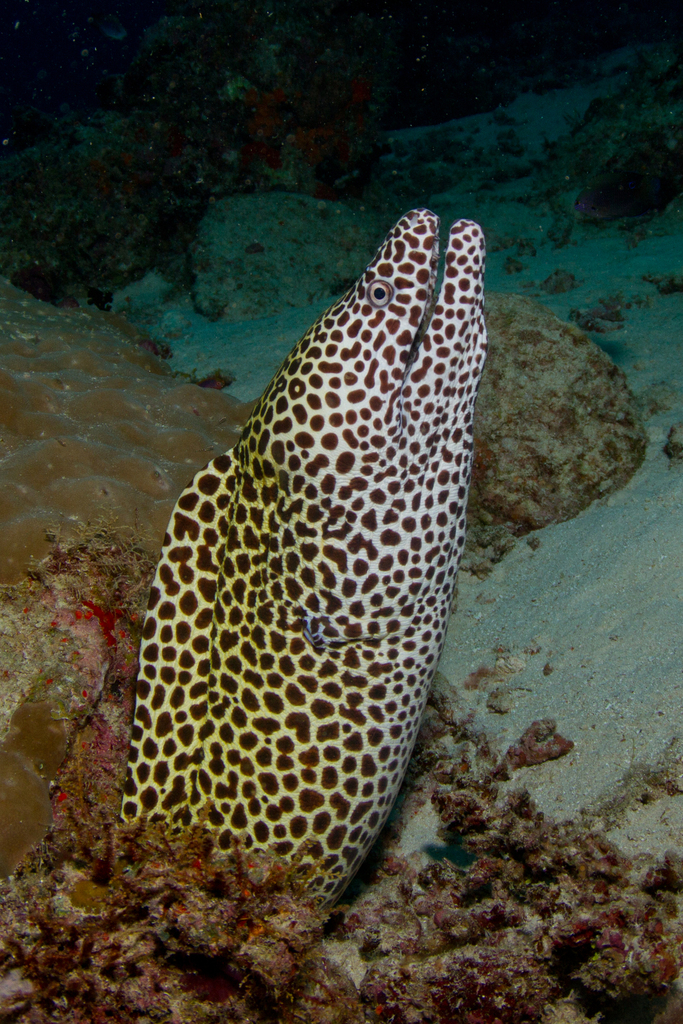
Honeycomb Moray Eel in Mauritius — Gymnothorax favagineus
The honeycomb moray eel (Gymnothorax favagineus), known in French as the murène en nid d'abeilles, is one of the largest and most recognisable moray eels in the Indo-Pacific. In Mauritius, it is a common resident of coral reefs, drop-offs, and rocky outcrops, where it finds shelter in caves and crevices at depths ranging from 1 to over 40 metres.
Identification
The honeycomb moray is impossible to mistake. Its body is covered in a striking black-and-white tessellated pattern — a mosaic of dark spots on a pale background that resembles a honeycomb or leopard print. Adults regularly reach 2 to 3 metres in length and can weigh several kilograms, making this one of the largest moray species in the ocean. Like all morays, it continuously opens and closes its mouth — not as a threat display, but simply to pump oxygenated water over its gills.
Behaviour and Diet
Primarily nocturnal hunters, honeycomb morays are most active at night, ambushing fish, crustaceans, and octopuses with their powerful jaws. They possess a unique anatomical feature found in all morays: a second set of jaws — called pharyngeal jaws — that lunge forward to drag prey into the throat. Despite their fierce appearance, honeycomb morays are generally docile towards divers when undisturbed. During the day, they retreat into reef crevices, with just their head protruding, making them wonderfully photogenic subjects.
Interestingly, honeycomb morays are occasionally observed in a cooperative hunting relationship with Napoleon wrasse and groupers, working alongside these fish to flush prey out of tight hiding places — a rare and captivating behaviour to witness underwater.
Habitat in Mauritius
In Mauritius, honeycomb morays inhabit the island's diverse reef systems, from the shallow lagoons of the west coast to the deeper outer reef slopes and coral gardens of the north and south. They are particularly fond of coral rubble zones, overhangs, and coral bommies where hiding spaces are plentiful. Both beginner snorkellers in protected lagoons and experienced divers on deep wall dives have opportunities to encounter this species.
Best Dive Sites to See Honeycomb Morays in Mauritius
Several of Mauritius's most celebrated dive sites offer reliable sightings of honeycomb moray eels. Shark Pool and Cathedral near Flic en Flac on the west coast are renowned for resident morays sheltering in their caverns. Coin de Mire in the north provides excellent visibility and rich reef habitats where large specimens are regularly spotted. The wrecks and reefs around Blue Bay Marine Park in the south-east are also productive areas.
Diving Tips
- Move slowly and calmly — sudden movements may startle the eel and cause it to retreat deeper into its crevice.
- Never attempt to touch or feed a moray eel; their bite is powerful and can cause serious injury.
- Bring a torch or dive light to illuminate the dark recesses where morays hide — this also reveals their spectacular colouring in full detail.
- Early morning and late afternoon dives tend to yield the most active behaviour as eels transition between resting and hunting.
Ecological Role
As apex reef predators, honeycomb morays play a critical role in maintaining reef ecosystem balance, controlling populations of fish and invertebrates. Their presence is a strong indicator of a healthy, well-established reef system. Protecting the coral habitats of Mauritius through responsible diving and marine conservation efforts ensures that future generations of divers can continue to enjoy encounters with these magnificent animals.