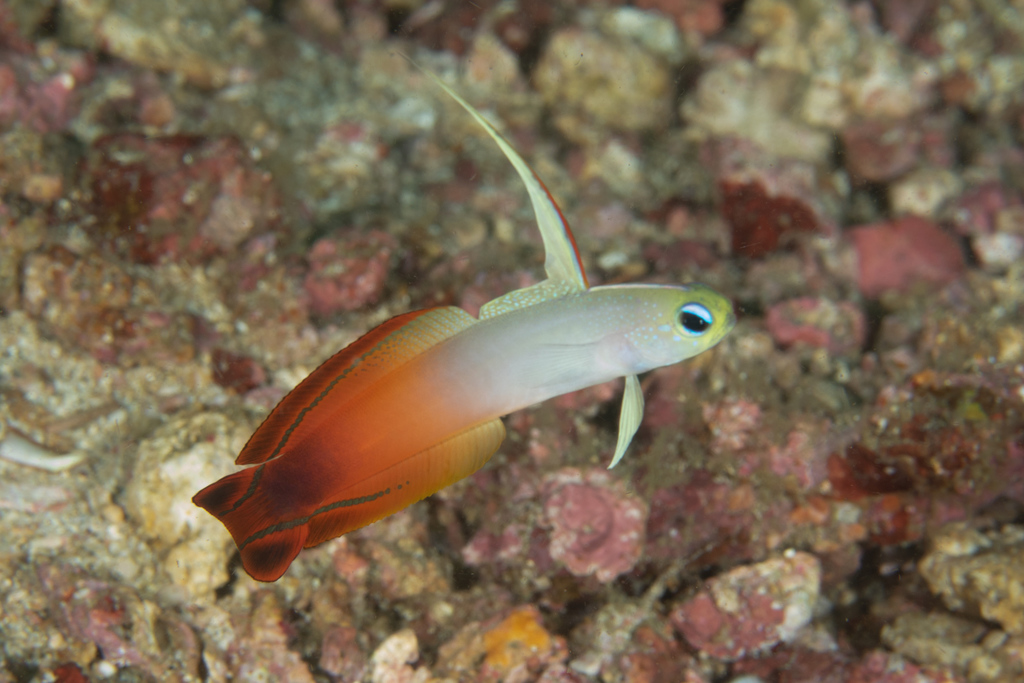
Fire Goby in Mauritius — Nemateleotris magnifica
The Fire Goby, known locally as the Gobie de feu and scientifically as Nemateleotris magnifica, is one of the most visually striking small reef fish inhabiting the warm, clear waters surrounding the island of Mauritius. Despite reaching only 7–9 cm in length, this tiny fish commands attention wherever it appears, thanks to its extraordinary coloration and graceful, hovering swimming style.
Appearance and Identification
The Fire Goby is immediately recognisable by its unique two-toned colouration. The front half of its slender, elongated body is a pristine, almost luminous white or pale yellow, while the rear half blazes in vivid shades of orange, red, and deep crimson — giving the fish its fiery common name. Its most distinctive feature is the remarkably long first dorsal spine, which can be as tall as the fish's own body. The fish rhythmically flicks this spine up and down, a behaviour thought to serve as a communication signal between individuals sharing the same territory. The tail fin is rounded and framed with the same warm hues as the posterior body, completing one of the ocean's most elegant colour schemes.
Behaviour and Habitat
In Mauritius, Fire Gobies are commonly encountered at depths ranging from 6 to 30 metres, typically hovering in pairs or small groups just above rubble patches, sandy channels, and the sloping bases of coral reefs. They are creatures of habit, almost always staying within a metre or two of a burrow or crevice into which they dart at lightning speed when threatened. This shy, retreating behaviour makes patience the key virtue for any diver hoping to observe them up close.
Fire Gobies feed by picking zooplankton and tiny invertebrates from the current as it drifts past their chosen hover spot, making areas with mild to moderate water movement particularly productive places to look for them. Pairs are often observed hovering side by side, and the species is believed to form monogamous bonds — a charming behavioural trait that makes spotting a couple in their natural setting even more rewarding.
Diving with Fire Gobies in Mauritius
Mauritius offers exceptional conditions for observing Fire Gobies, with warm, clear water and an abundance of healthy reef ecosystems along both the western and northern coasts. The island's protected lagoons and sheltered outer reef slopes provide exactly the kind of calm, current-influenced habitat these fish favour. Underwater photographers particularly love Fire Gobies for their vivid colours and relatively predictable positioning — though getting close enough for a detailed shot does require slow, deliberate movements and a calm approach.
The best strategy is to spot a pair hovering above the substrate, then gradually reduce your distance over several minutes. Any sudden movement will send them retreating into their burrow, where they may remain hidden for several minutes before cautiously re-emerging. Using a wide angle or macro lens while hovering neutrally at their level — rather than approaching from above — greatly improves your chances of a successful photograph.
Ecological Role
As planktivores, Fire Gobies play a small but meaningful role in the reef food web, helping to transfer energy from the water column to the benthic community. They are also prey items for a variety of reef predators, including larger reef fish and cephalopods, meaning their cautious, burrow-dependent lifestyle is essential to their survival. Their presence is generally considered a good indicator of a healthy, well-structured reef ecosystem with stable sandy or rubble substrates.
Conservation in Mauritius
The Fire Goby is currently listed as Least Concern on the IUCN Red List, and populations in Mauritius appear stable. However, like all reef-dependent species, they benefit from the ongoing protection of coral reef habitats through Mauritius's marine protected areas and responsible dive tourism practices. Avoiding reef contact, not disturbing burrow sites, and supporting sustainably managed dive operators all contribute to the long-term health of Fire Goby populations in Mauritian waters.