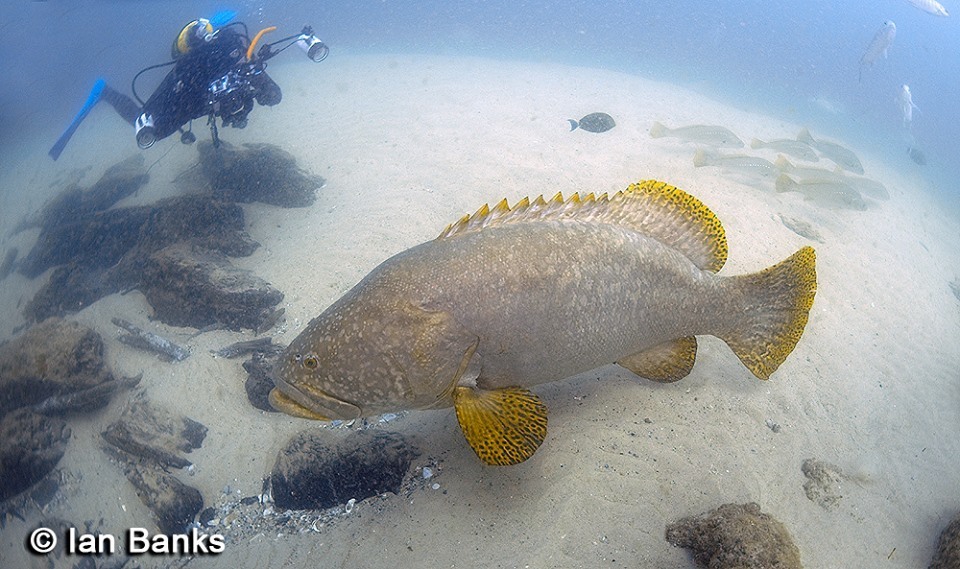
Giant Grouper in Mauritius: The Ocean's Gentle Giant
The giant grouper (Epinephelus lanceolatus), called Mérou géant in French, is the largest bony fish found on coral reefs anywhere in the world. In Mauritius, sightings of this magnificent species are genuinely rare and treasured, making any encounter one of the most extraordinary moments a diver can experience in the Indian Ocean.
Physical Characteristics
Giant groupers are immediately recognisable by their sheer bulk and distinctive appearance. Adults display a greyish-brown to olive body patterned with irregular dark blotches and small black spots, which gradually fade as the fish matures. Their broad, rounded head, cavernous mouth, and powerful tail make them unmistakable. Juveniles, by contrast, are strikingly different — boldly marked with irregular black and yellow patches that provide excellent camouflage among coral rubble.
This species is a protogynous hermaphrodite, meaning individuals begin life as females and may transition to males as they grow larger and older. They are slow to mature, long-lived, and reproduce infrequently — biological traits that make population recovery extremely difficult when numbers decline.
Behaviour and Ecology
Giant groupers are apex predators that feed on a wide variety of prey including spiny lobsters, small sea turtles, juvenile sharks, rays, and a range of bony fish. Despite their fearsome reputation, they are generally docile towards divers and display a calm, almost curious demeanour. However, they should always be respected and given ample space.
These fish are largely solitary and highly territorial. They favour specific caves, overhangs, and deep reef structures where they rest for long periods, ambushing prey that ventures too close. In Mauritius, the few documented individuals tend to return to the same locations year after year, which is a hopeful sign for local monitoring efforts.
Where to See Giant Groupers in Mauritius
Due to their rarity, there are no guaranteed locations for spotting giant groupers in Mauritius. However, the best chances come from diving at deeper reef sites along the south and west coasts, particularly around steep wall dives and areas with well-developed coral ecosystems. Sites like Coin de Mire in the north and the Passe de Belombre are occasionally cited by dive operators as areas where large grouper species have been reported. Patience, calm behaviour underwater, and early morning dives significantly improve your chances.
Conservation Status and Threats
The giant grouper is classified as Vulnerable on the IUCN Red List. Globally, populations have declined significantly due to overfishing — they are prized as a food fish across Asia and the Indo-Pacific. Spearfishing and targeted commercial fishing have devastated local populations in many parts of their range. In Mauritius, marine protected areas and increasing environmental awareness offer some degree of protection, but enforcement remains a challenge.
Because giant groupers congregate predictably at spawning aggregation sites, they are particularly susceptible to mass harvesting during breeding seasons. Supporting responsible dive operators, advocating for expanded marine protected areas, and reporting sightings to local conservation bodies all contribute meaningfully to the survival of this species.
Diving Tips for Spotting Giant Groupers
- Dive deep and early: Giant groupers tend to inhabit deeper sections of the reef, often between 20 and 50 metres. Early morning dives are best before reef traffic disturbs them.
- Move slowly and quietly: Sudden movements will cause them to retreat into caves. Approach gradually and let them grow accustomed to your presence.
- Look in the shadows: Check overhangs, cave entrances, and dark crevices — their favourite resting spots.
- Ask local dive guides: Experienced Mauritian dive masters often know if a resident giant grouper inhabits a particular site.
A sighting of a giant grouper in Mauritius is never guaranteed — but that rarity is precisely what makes it so special. These ancient, gentle giants are living symbols of what healthy oceans can sustain, and every responsible encounter is a privilege worth protecting.