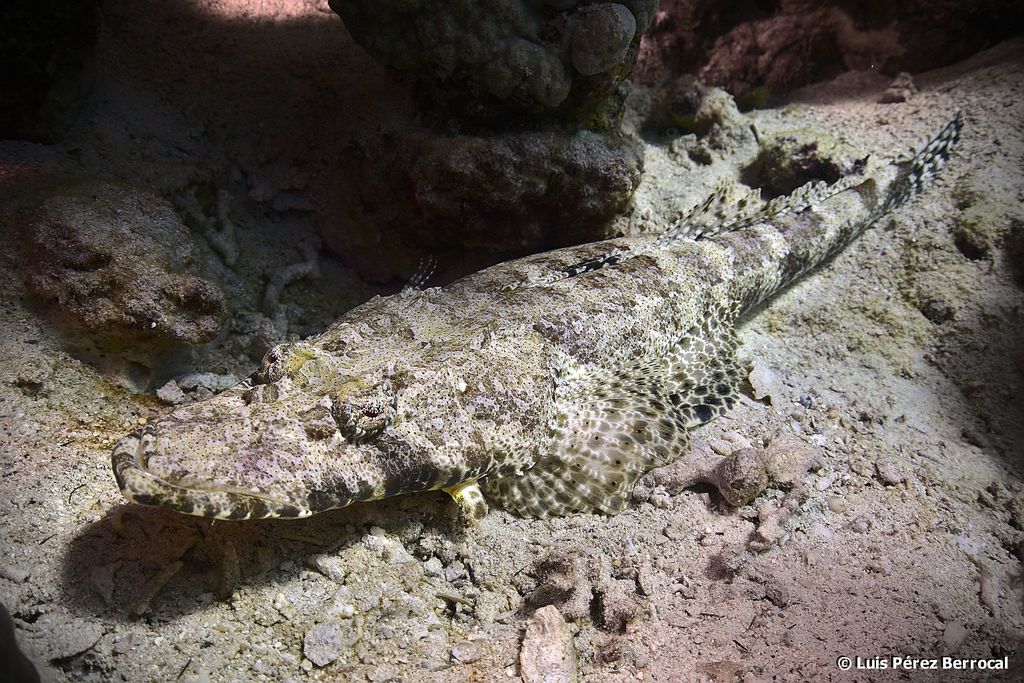
Crocodilefish in Mauritius: The Master of Disguise
The Crocodilefish (Papilloculiceps longiceps), known locally as Poisson crocodile, is one of the most fascinating and perfectly camouflaged fish you will encounter while diving or snorkelling in Mauritius. Belonging to the family Platycephalidae (flatheads), this species earns its dramatic common name from its elongated, flattened head and body that bears a striking resemblance to a crocodile resting at the water's edge.
Identification & Physical Characteristics
Growing up to 70 cm in length, the Crocodilefish is a large and impressive flathead. Its body is perfectly designed for concealment — a mottled mosaic of browns, tans, greys, and sandy hues that mirrors the rubble, coral fragments, and sandy seabeds it inhabits. One of its most remarkable features is its fringed iris (called a lappet), which breaks up the outline of its eye and makes even this potentially tell-tale feature nearly invisible. Its broad, flattened head is adorned with ridges and spines, further enhancing the impression of a rough piece of dead coral or a lump of rubble.
Unlike many reef fish that dart away at the approach of a diver, the Crocodilefish relies entirely on its camouflage for protection. It will remain absolutely motionless, trusting its disguise, even when approached closely. This behaviour makes it a dream subject for underwater photographers.
Behaviour & Feeding
The Crocodilefish is a classic ambush predator. It lies in wait on the seabed, often for hours, until an unsuspecting small fish or crustacean ventures within striking distance. It then strikes with explosive speed, engulfing its prey in its wide, upturned mouth in a fraction of a second. This sit-and-wait strategy means it expends very little energy and can be observed resting in the same spot for extended periods — a boon for patient divers keen on a long observation.
These fish are largely solitary and nocturnal hunters, although they can be active at any time of day. They are commonly spotted resting on sandy patches between coral heads, on rubble slopes at the base of the reef, or even on the upper surface of large coral formations. Their incredible stillness and camouflage mean they are frequently missed by inexperienced divers — spotting one is considered a true achievement.
Habitat in Mauritius
In Mauritius, Crocodilefish are commonly found at depths ranging from just 1 metre in shallow lagoons to over 30 metres on deeper reef slopes. They favour sandy and rubble substrate adjacent to coral reef structures, where their camouflage is most effective. The warm, clear waters of the Mauritian lagoons and the sheltered reef systems inside the barrier reef provide ideal conditions for this species year-round.
Both novice snorkellers exploring the shallows and experienced scuba divers venturing deeper stand a good chance of encountering a Crocodilefish, provided they take time to scan the bottom carefully and look for that tell-tale outline hiding in plain sight.
Snorkelling & Diving Tips
- Slow down and scan — Crocodilefish are invisible to those who rush. Take your time and look for the subtle outline of a flattened head.
- Look for the eye — Despite the lappet camouflage, the eye can catch the light and reveal the fish's position.
- Don't touch — While not highly venomous like scorpionfish, Crocodilefish have spiny fins and should never be handled.
- Bring a torch — Even on daytime dives, a torch helps reveal the fine detail of this fish's extraordinary patterning.
Photography
The Crocodilefish is one of the most rewarding macro and wide-angle subjects on Mauritian reefs. Its tolerance of close approach allows for stunning portrait shots, particularly of the extraordinary fringed eye. Use a wide aperture to blur the background and make the intricate skin texture the centrepiece of your image.