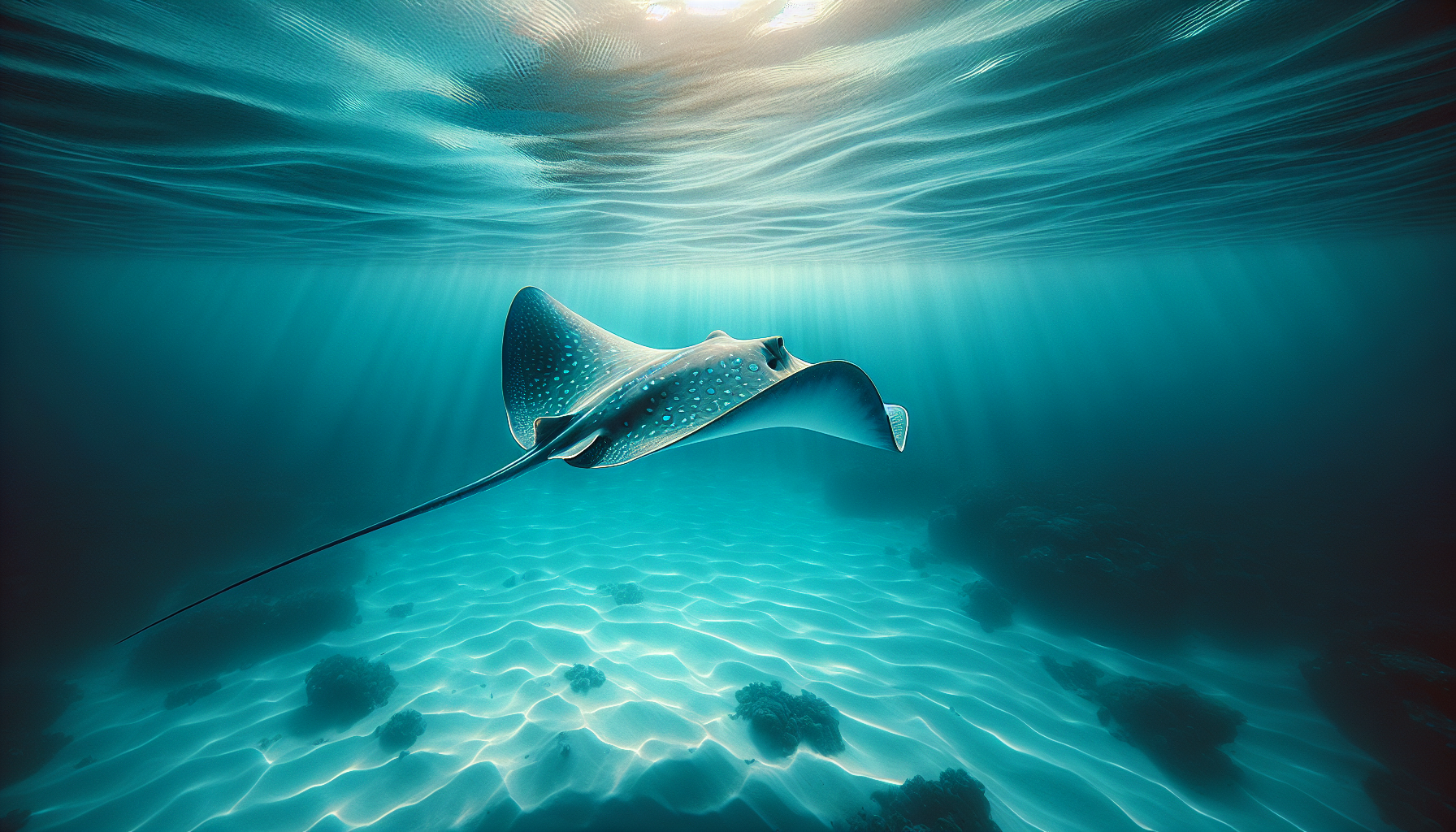
Cowtail Stingray in Mauritius — Pastinachus sephen
The cowtail stingray (Pastinachus sephen), affectionately called the Raie à queue de vache in Mauritius, is one of the island's most commonly encountered elasmobranch species. Belonging to the family Dasyatidae, this large, striking ray is immediately recognisable by its broad, diamond-shaped pectoral disc, dark olive-brown to grey dorsal surface, and its uniquely flattened, strap-like tail that resembles a cow's tail — the feature that gives it its memorable common name.
Physical Characteristics
Adult cowtail stingrays can reach a disc width of up to 180 cm and weigh as much as 250 kg, making them one of the largest inshore stingrays in the Indo-Pacific region. The underside is pale white to cream, providing a classic example of countershading camouflage. The tail, which is considerably longer than the disc, bears one or two venomous serrated spines near its base — a defensive adaptation rather than an aggressive one. The skin along the tail is notably flattened and ribbon-like, a trait unique to this species among Indian Ocean rays.
Behaviour and Diet
Cowtail stingrays are benthic feeders, spending much of their time cruising slowly across sandy substrates, seagrass beds, and rubble zones in search of food. Their diet consists primarily of bivalves, crustaceans, polychaete worms, and small fish, which they excavate from the seafloor using their flat, crushing teeth. It is not uncommon to observe them actively fanning the seabed with their fins to expose buried prey — a behaviour that local divers find both fascinating and endearing.
These rays are largely solitary but can occasionally be found resting in loose aggregations on sandy bottoms, particularly in sheltered lagoon environments. They are generally docile towards divers and will often allow close observation if approached slowly and calmly. However, like all stingrays, they should never be touched or harassed, as their tail spine can deliver a painful and potentially dangerous wound.
Habitat in Mauritius
In Mauritius, cowtail stingrays favour the shallow coastal lagoons, sandy channels between reefs, and the inner slopes of the fringing reef. They are most frequently encountered at depths between 2 and 30 metres, though they have been recorded deeper on the outer reef plateaus. The warm, sheltered waters on the western and northern coasts of Mauritius provide ideal habitat, offering rich benthic communities and calm conditions year-round.
Ecological Role
As mid-level predators, cowtail stingrays play an important role in structuring benthic communities. Their feeding behaviour aerates the seabed and redistributes nutrients, while they themselves serve as prey for larger sharks and marine mammals. They are also hosts to several species of remora fish, which can often be seen clinging to their undersides, and cleaner wrasses that pick parasites from their skin — a reminder of the complex ecological web in which they participate.
Diving with Cowtail Stingrays in Mauritius
Encountering a cowtail stingray underwater is a highlight of any Mauritius dive trip. The best strategy is to approach slowly at the same depth, avoid sudden movements, and give the animal space to move away at will. Many individuals in popular dive areas have become accustomed to divers and will continue feeding undisturbed. Always follow responsible wildlife interaction guidelines and never attempt to ride or touch the ray.
Mauritius's year-round warm waters mean cowtail stingrays are present across all seasons, though sightings tend to increase during the calmer summer months from October to April, when underwater visibility is at its best and the rays are more active in the shallows.
Conservation
The cowtail stingray is currently listed as Vulnerable on the IUCN Red List, facing threats from artisanal and commercial fisheries, habitat degradation, and bycatch. In Mauritius, growing awareness among the diving community has helped promote a culture of respect and non-interference, contributing to local conservation efforts for this iconic species.