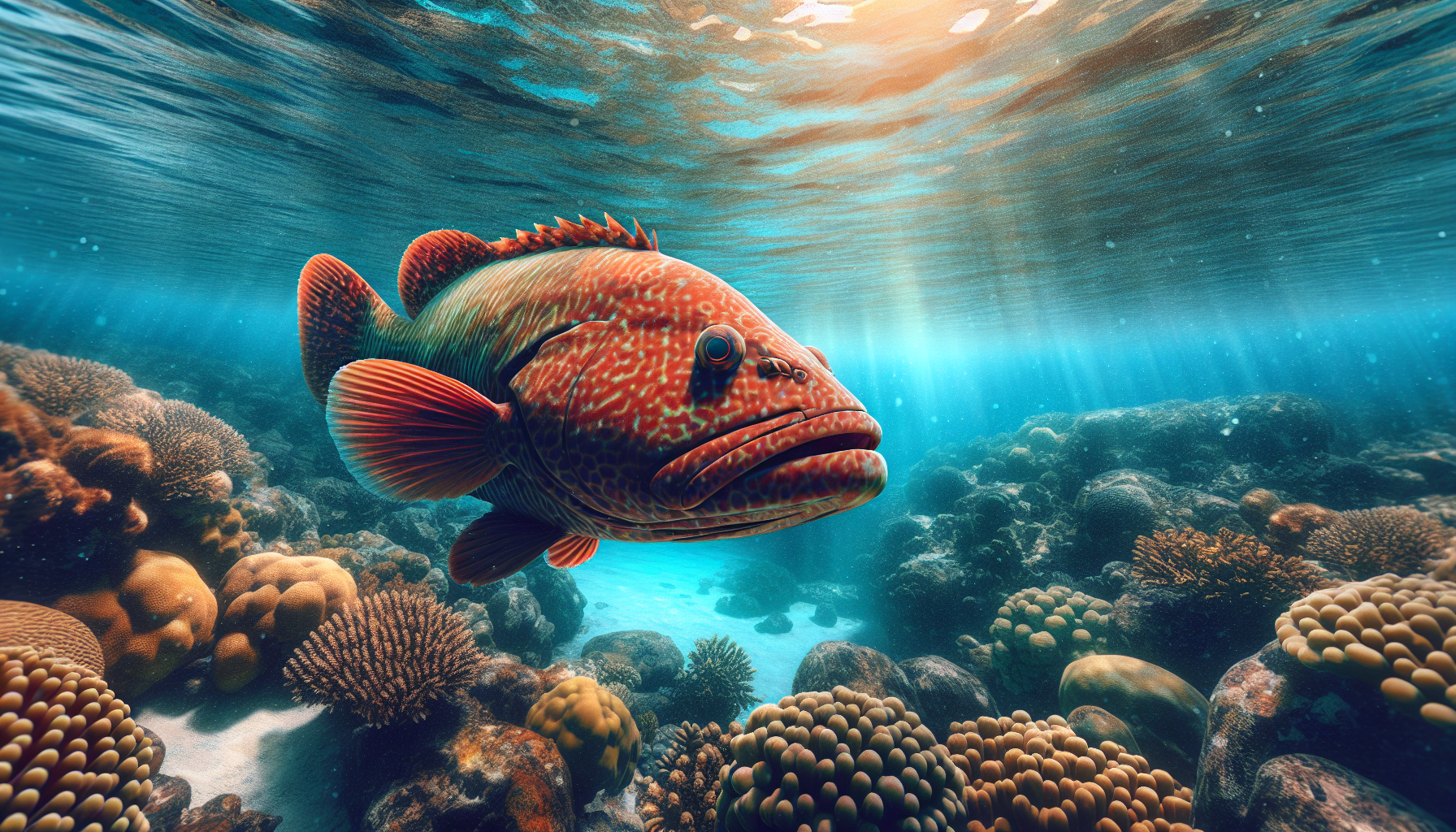
Coral Grouper in Mauritius: The Jewel of the Reef
The Coral Grouper (Cephalopholis miniata), called Mérou corail in Mauritius, is one of the most visually striking fish you will encounter on Mauritian reefs. Dressed in a rich orange-red body covered with dozens of iridescent blue spots, this medium-sized grouper rarely fails to stop divers in their tracks. Reaching lengths of up to 45 cm, it occupies a prominent position in the reef ecosystem — both as a predator and as a subject of fascination for underwater photographers and naturalists alike.
Identification and Physical Characteristics
Cephalopholis miniata is relatively easy to identify thanks to its unmistakable colouration. The body ranges from bright vermilion to deep reddish-orange, with small, vivid blue or cyan spots distributed uniformly across the head, body, and fins. The edges of the dorsal, anal, and caudal fins are often highlighted with a thin blue border, adding to its jewel-like appearance. Unlike some of its larger grouper cousins, the Coral Grouper has a more compact, robust build with a rounded caudal fin. Juveniles display a similar pattern but with more pronounced spots relative to body size.
Behaviour and Ecology
The Coral Grouper is a solitary, territorial predator that typically inhabits depths between 2 and 150 metres, though it is most commonly seen between 5 and 40 metres on Mauritian dive sites. It favours areas of rich coral growth, particularly along steep drop-offs, coral bommies, and reef walls where it can ambush small fish and crustaceans. Like all groupers, it is a protogynous hermaphrodite — individuals begin life as females and may transition to males later in life, a fascinating adaptation that helps maintain population stability.
During the day, the Coral Grouper is often found resting on or near coral outcrops, scanning its territory with alert, wide-set eyes. It is not particularly shy around divers and will often allow a close approach, making it a favourite subject for underwater photography. At dawn and dusk, it becomes more actively predatory, using short bursts of speed to ambush prey.
Coral Grouper and the Reef Ecosystem
As a mid-level predator, the Coral Grouper plays a vital role in maintaining the balance of reef ecosystems in Mauritius. By controlling populations of small reef fish and invertebrates, it helps prevent any single species from dominating and degrading the reef structure. Healthy grouper populations are widely considered an indicator of a thriving, well-balanced coral reef — making the common presence of Cephalopholis miniata in Mauritian waters a reassuring sign of the islands' reef health.
Diving with Coral Grouper in Mauritius
Mauritius offers exceptional opportunities to observe the Coral Grouper across a variety of dive environments. The species is classed as common in Mauritian waters, and experienced dive guides know exactly where to find resident individuals. Sites along the west coast — including the famous Cathedral dive site — and the clear waters of the north and east regularly yield superb sightings. The Coral Grouper tends to favour specific territories, meaning that a grouper spotted on one dive is likely to be found in the same area on subsequent visits.
Underwater photographers are advised to approach slowly and diagonally rather than head-on, allowing the fish to become accustomed to your presence. A wide-angle lens captures the full beauty of its colouration against a backdrop of corals, while a macro lens can highlight the extraordinary detail of its spotted pattern up close.
Conservation and Sustainable Diving
While the Coral Grouper is currently listed as Least Concern by the IUCN, grouper species globally face pressures from overfishing and habitat loss. In Mauritius, responsible fishing regulations and marine protected areas help safeguard reef fish populations. Divers can contribute by practising no-touch diving, avoiding anchor damage to corals, and supporting dive operators committed to marine conservation. Every respectful encounter with a Coral Grouper helps reinforce the value of protecting Mauritius's extraordinary underwater heritage for future generations.