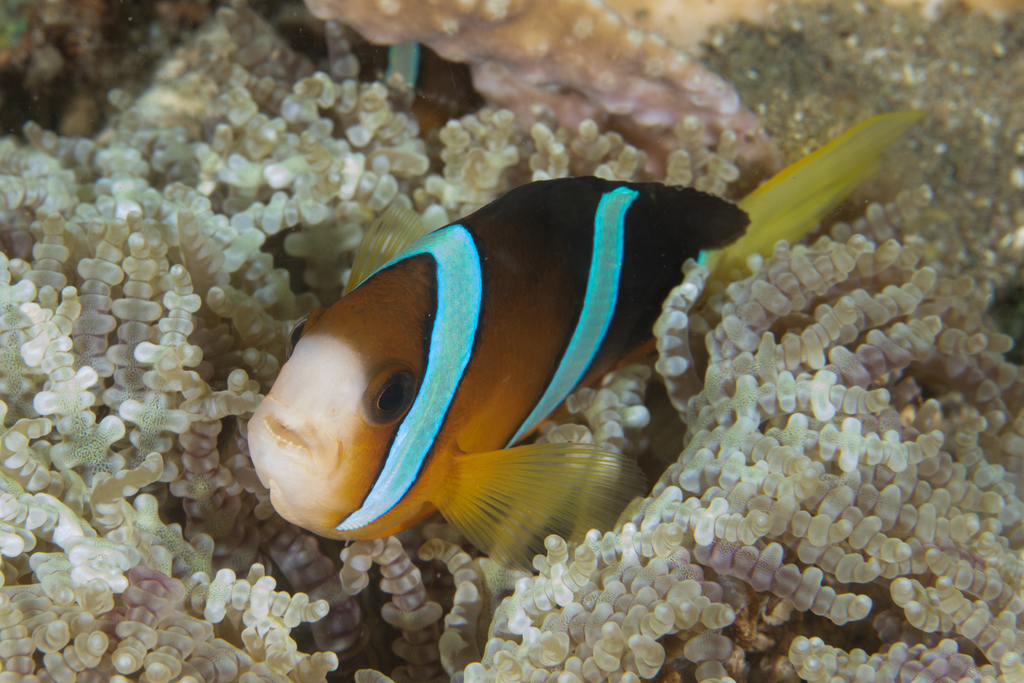
Clark's Anemonefish in Mauritius: The Ocean's Bold Little Clown
Amphiprion clarkii, commonly known as Clark's anemonefish or the yellowtail clownfish, is one of the most widespread and visually stunning anemonefish species found across the Indo-Pacific. In Mauritius, it is a common and reliable sight on coral reefs, delighting divers and snorkellers with its bold personality and vibrant colouration. Unlike the more famous orange clownfish of cinema fame, Clark's anemonefish boasts a dramatic combination of deep black or dark brown body, bright white stripes, and vivid yellow-orange fins and tail — a colour scheme that makes it instantly recognisable underwater.
Biology and Behaviour
Clark's anemonefish is a small reef fish, typically reaching between 8 and 15 centimetres in length. Like all anemonefish, it lives in a remarkable symbiotic relationship with sea anemones, most commonly associating with species such as Heteractis crispa, Stichodactyla mertensii, and Entacmaea quadricolor. The fish produces a special mucus coating that prevents the anemone's stinging nematocysts from firing, giving it a safe haven among tentacles that would paralyse most other small fish.
In return, Clark's anemonefish fiercely defends its host anemone against predators, chasing away much larger fish with astonishing bravery. The fish also contributes to the anemone's health by improving water circulation through its constant movement, removing parasites, and providing nutrients through its waste. This mutual relationship is one of the ocean's most celebrated examples of symbiosis.
Clark's anemonefish is also a sequential hermaphrodite — all individuals are born male, and the dominant fish in any group will transition to female if the resident female dies or disappears. This fascinating biological trait ensures that any anemone host always has a breeding pair in residence. Females are typically larger than males, and breeding pairs can be observed tending small clutches of eggs laid on flat rock surfaces near the anemone base.
Identifying Clark's Anemonefish
In Mauritius, Clark's anemonefish can be distinguished from other anemonefish species by several key features:
- A dark body ranging from black to very dark brown
- Two or three bright white vertical bars across the body
- A distinctly yellow or orange tail fin
- Yellow-orange pectoral fins and snout
- Relatively larger size compared to other anemonefish species
Diving with Clark's Anemonefish in Mauritius
Mauritius offers excellent conditions for observing Clark's anemonefish in its natural habitat. The species thrives on the island's well-preserved fringing reefs, lagoon floors, and outer reef slopes at depths ranging from as shallow as 1 metre to over 15 metres. Because it rarely strays more than a metre or two from its host anemone, once you spot an anemone on the reef, there is a very good chance a pair or small group of Clark's anemonefish will be in residence nearby.
The fish's bold nature means it rarely hides from divers — instead, it may actually swim towards you in a show of territorial bravado, making for perfect photography opportunities. Underwater photographers will appreciate how the dark body and vivid markings contrast beautifully against the purple, green, and pink hues of the anemone tentacles.
Snorkelling in the calm lagoons of Blue Bay Marine Park or around the reefs of the west coast can reward visitors with sightings even without scuba equipment. For divers, the richer and deeper reef structures around Flic en Flac and the south coast provide reliable encounters with established anemonefish colonies throughout the year.
Conservation
Clark's anemonefish is currently listed as Least Concern on the IUCN Red List, reflecting its wide distribution and healthy populations. However, its dependence on sea anemones — which are themselves vulnerable to coral bleaching events driven by rising ocean temperatures — means that climate change poses an indirect but growing threat. In Mauritius, responsible reef conservation and the protection of marine parks play a vital role in maintaining healthy anemone populations and, by extension, the anemonefish that depend on them.