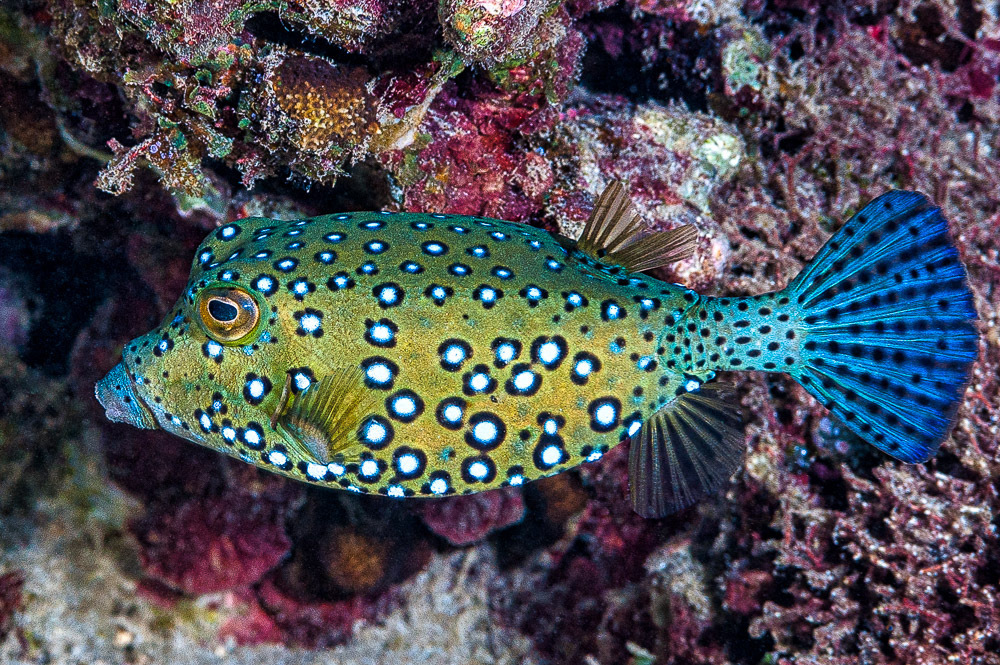
Yellow Boxfish in Mauritius: The Reef's Living Treasure Chest
Few marine creatures capture the imagination quite like the Yellow Boxfish (Ostracion cubicus), a quirky, cube-shaped fish that has become one of the most beloved sights on the coral reefs of Mauritius. Encased in a rigid bony carapace and adorned with vivid yellow skin covered in dark blue or black polka dots, this fish looks almost too cartoonish to be real. Yet it is very real — and very common in the shallow to mid-depth reef systems that fringe the Mauritian coastline.
Appearance and Identification
The Yellow Boxfish gets its common name from its remarkably box-like body shape, formed by a fused network of hexagonal bony plates beneath the skin. Juveniles are perhaps even more striking than adults, displaying a brilliant lemon-yellow coloration with bold black spots arranged in neat patterns. As they mature, males often transition to a more muted bluish-grey with yellow markings and intricate patterns, while females tend to retain a darker brown or olive hue. Adults typically measure between 20 and 45 centimetres in length, though individuals over 30 cm are less commonly encountered. The fish propels itself through the water using a characteristic sculling motion of its dorsal, pectoral, and anal fins — its rigid body preventing any traditional tail-powered swimming.
Behaviour and Diet
Yellow Boxfish are generally solitary and slow-moving, spending their days methodically picking at the reef in search of food. Their diet is varied and includes algae, small invertebrates, sponges, worms, crustaceans, and molluscs. They use their protruding lips to blow jets of water into the sandy substrate, exposing hidden prey beneath. Despite their docile appearance, Yellow Boxfish possess a remarkable chemical defence mechanism — when stressed or threatened, they can release a toxic substance called ostracitoxin (also called pahutoxin) from their skin, which can be lethal to other fish in an enclosed environment. In the open ocean, however, this toxin disperses quickly and poses no real danger to divers or snorkelers.
Habitat and Distribution in Mauritius
In Mauritius, the Yellow Boxfish is considered a common species across most reef environments. It favours shallow coral reef flats, lagoon systems, and drop-off walls at depths ranging from just 1 metre down to approximately 35 metres. It is frequently encountered hovering near coral heads, rubble patches, and sandy-bottomed reef areas where foraging is productive. The warm, clear waters of the Mauritian lagoons — particularly on the west and north coasts — provide ideal habitat, and sightings are reported year-round with great regularity.
Snorkelling and Diving with Yellow Boxfish
Thanks to their slow, predictable movements and relatively unfazed disposition toward human observers, Yellow Boxfish are perfect subjects for underwater photography. Their vivid colouration and unique shape make them highly photogenic, and their habit of hovering close to coral structures means patient divers can often spend extended time observing them without disturbance. It's important, however, to avoid chasing or handling these fish, as stress can trigger their toxin release and compromise their wellbeing. Responsible reef etiquette ensures that both the fish and the broader reef ecosystem remain healthy for future generations of divers.
Ecological Role
As grazers and invertebrate predators, Yellow Boxfish play a modest but meaningful role in maintaining reef health. By feeding on algae, they help prevent algal overgrowth that could smother coral, and their foraging behaviour in sandy substrates contributes to nutrient cycling within the reef ecosystem. Their presence is generally an indicator of a healthy, well-structured reef environment — making them a welcome sight on any Mauritian dive.
Conservation
The Yellow Boxfish is currently classified as a species of Least Concern by the IUCN Red List. In Mauritius, it benefits from the general protections afforded to marine life within designated Marine Protected Areas (MPAs). While not a targeted species for commercial fishing, habitat degradation from coastal development, coral bleaching, and pollution remains a broader threat to the reef ecosystems it depends upon. Supporting responsible dive operators and marine conservation initiatives in Mauritius helps safeguard these reefs for the future.