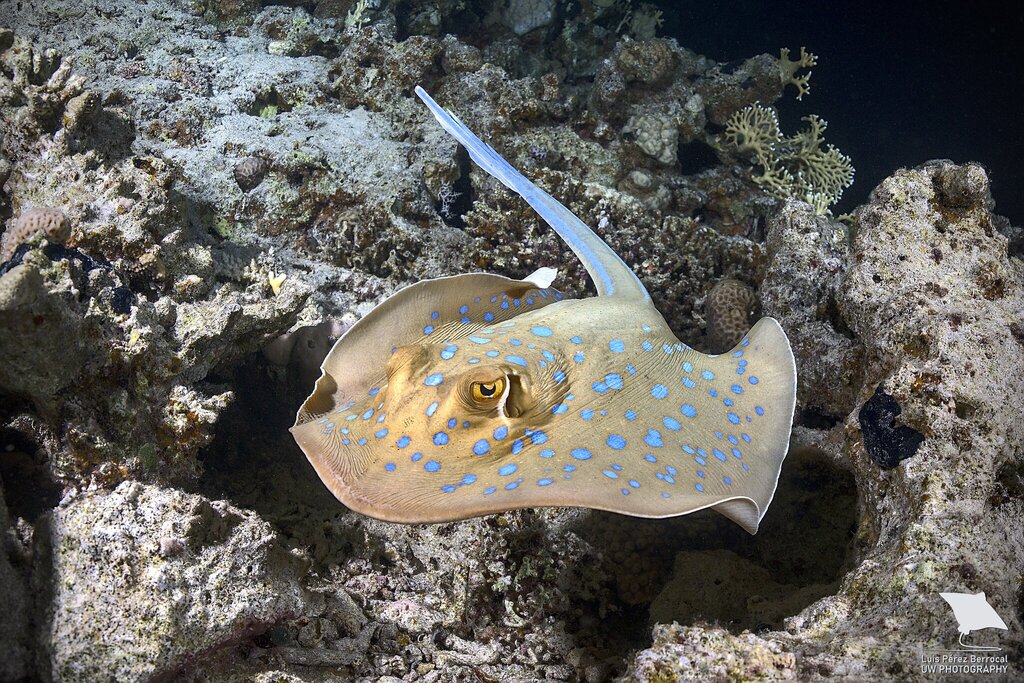
Blue-Spotted Stingray in Mauritius (Taeniura lymma)
Few marine encounters in Mauritius are as memorable as coming face-to-face with the blue-spotted stingray (Taeniura lymma), known locally as the raie pastenague à points bleus. Recognisable by its striking electric-blue spots and vivid yellow-orange disc, this medium-sized ray is a common and beloved resident of Mauritian reefs, lagoons, and sandy flats.
Identification & Appearance
The blue-spotted stingray is relatively compact compared to other stingray species, with an oval, flattened disc typically measuring between 30 and 70 cm across. Its dorsal surface is a warm tan or olive-yellow adorned with brilliant blue spots — a coloration that serves as a warning to potential predators. The long, whip-like tail carries one or two venomous spines near its base, used purely for defence. The underside is pale white, making it easy to identify when it lifts gently off the sand.
Behaviour & Ecology
Taeniura lymma is a benthic species, meaning it spends most of its time close to the seafloor. In Mauritius, it is regularly observed resting motionless beneath coral overhangs, partially buried in sandy patches, or gliding slowly over rubble fields in search of prey. Its diet consists primarily of molluscs, worms, shrimps, and small crustaceans, which it detects using electroreceptors embedded in its snout.
Unlike some rays that are highly migratory, the blue-spotted stingray tends to remain in relatively defined home ranges along the reef. During high tide it will venture onto shallower sandy flats and reef edges to forage, retreating to sheltered crevices as the tide drops. This tidal behaviour makes it predictable for divers and snorkellers who time their entries correctly.
Where to See Blue-Spotted Stingrays in Mauritius
The blue-spotted stingray is considered common in Mauritius and can be found across a wide range of dive environments, from the shallow coral gardens of the north to the sheltered lagoons of the west coast. Sites with a mixture of sandy corridors and coral bommies are particularly productive. Divers exploring the famous passes and channels around the island frequently spot rays resting beneath table corals or cruising along the reef edge at depths between 5 and 25 metres.
Snorkellers also have excellent opportunities in the shallower lagoons, particularly in the early morning when rays are most active along sandy margins. The calm, clear waters of the western and northern lagoons of Mauritius offer ideal visibility for observing this species without disturbing it.
Diving Tips & Safety
While the blue-spotted stingray is generally docile and non-aggressive, it is important to maintain a respectful distance and never attempt to touch or corner the animal. If threatened, a stingray may arch its tail defensively. Always approach slowly and from the front, allow the ray to be aware of your presence, and avoid hovering directly above the animal, which it can perceive as a predatory threat.
Wearing fins and wetsuits provides adequate protection when diving or snorkelling around sandy habitats where rays may be resting. Never shuffle your feet along the sand without first checking — a gentle tap on the seabed before entering shallows is a well-practised habit among Mauritian dive guides.
Conservation
The blue-spotted stingray is currently listed as Least Concern on the IUCN Red List, though populations across the Indo-Pacific face pressure from habitat degradation, coastal development, and incidental capture in artisanal fisheries. In Mauritius, marine protected areas and responsible dive tourism practices play an important role in safeguarding reef ecosystems that these rays depend upon. Choosing eco-conscious dive operators and following no-touch guidelines helps ensure this extraordinary species remains a fixture of Mauritian reefs for generations to come.