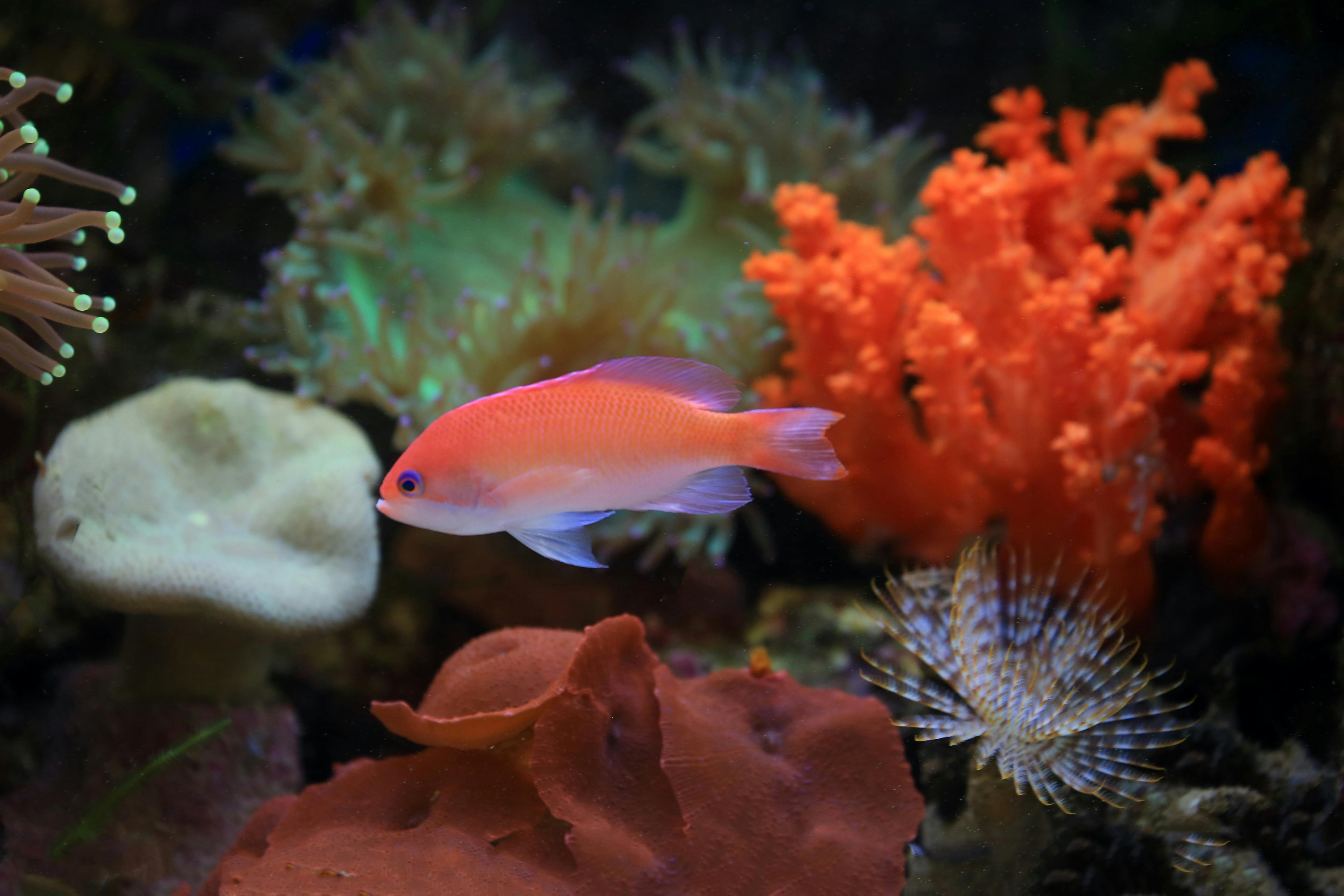
Anthias in Mauritius – The Jewels of the Reef
The Anthias (Pseudanthias squamipinnis), commonly known as the Scalefin Anthias or Sea Goldie, is one of the most iconic small reef fish found throughout the Indo-Pacific region. In Mauritius, these brilliant fish are a common and unmistakable presence on virtually every healthy coral reef, forming dense, swirling aggregations that bring colour and life to even the deepest drop-offs and shallowest lagoons.
Appearance and Identification
Anthias are immediately recognisable by their vivid colouration. Females display a brilliant orange-yellow body with a distinctive violet stripe running beneath each eye, while males are even more striking, boasting a deep rosy-red or magenta hue, elongated third dorsal fin spines, and a pronounced lunate tail adorned with trailing filaments. Adults typically reach 7–15 cm in length. Like many wrasse relatives, Anthias are protogynous hermaphrodites — if the dominant male of a group disappears, the largest female will change sex and take on his role, a fascinating biological adaptation that ensures group stability.
Behaviour and Social Structure
One of the most captivating aspects of Anthias is their complex social behaviour. They live in large harems, typically composed of one dominant male presiding over a group of females ranging from a handful to hundreds of individuals. These schools hover just above the reef structure, facing into the current to feed on zooplankton drifting past. Watch closely and you will notice the male patrolling his territory with energetic dips and swoops, displaying his vivid colours to maintain dominance. At any sign of danger, the entire school retreats as one fluid unit into the coral below, only to re-emerge seconds later in a mesmerising display of collective behaviour.
Role in the Reef Ecosystem
Despite their small size, Anthias play an important ecological role on Mauritius's coral reefs. As midwater planktivores, they form a vital link in the food chain, converting plankton into biomass that supports larger predators such as groupers, lionfish, and reef sharks. Their constant presence and activity also signals the overall health of a reef — dense aggregations of Anthias are typically a good indicator of a thriving, productive ecosystem.
Where to Find Anthias in Mauritius
Anthias are found island-wide wherever there is healthy coral reef structure. They are particularly abundant around coral bommies, drop-offs, and underwater pinnacles where current brings a steady supply of plankton. Some of the best dive sites in Mauritius to observe large schools include the famous Trou aux Biches reef systems in the north, the dramatic walls at Flic en Flac on the west coast, and the pristine reefs of Blue Bay Marine Park in the south. The outer reef edges of Grand Baie and the underwater cathedral at Cathedral Rock near Flic en Flac are especially rewarding.
Snorkelling and Diving with Anthias
One of the great advantages of seeking Anthias in Mauritius is that they can be observed at a range of depths, from as shallow as 3–5 metres in the lagoon to depths exceeding 30 metres along outer reef slopes. They are approachable with slow, calm movements and make exceptional subjects for underwater photography, particularly in the early morning when light conditions are ideal and the fish are most active in their feeding behaviour.
Conservation
In Mauritius, Anthias populations are generally stable and abundant on well-protected reefs. Their health is directly tied to the condition of the coral reef habitat, making efforts to protect Mauritius's marine parks and reduce reef degradation from pollution and climate change critically important for their long-term survival.